
Independent comparison site · Advertiser Disclosure Medical Alert: (877) 909-4209 | Lifeline: (877) 488-1101
Compare Options

How to Coordinate Care for an Aging Parent When Siblings Disagree

How to Coordinate Care for an Aging Parent When Siblings Disagree

Quick Answer: When siblings disagree about an aging parent’s care, start with your parent’s wishes and a shared understanding of what help is needed. Hold a focused family meeting, divide specific responsibilities, and write down commitments and costs. For unresolved medical, practical, or legal questions, involve the appropriate professional rather than letting an argument decide the outcome.

You may agree that your parent needs support but disagree about almost everything else: who should visit, whether paid help is necessary, or why one person is handling every appointment. The goal is not to settle every family disagreement. It is to build a workable care plan that respects your parent and does not rely on one sibling doing everything.

Why Siblings May See Caregiving Differently

A sibling who visits daily may notice difficulties that someone calling once a week never sees. Old family roles, different financial circumstances, and fears about a parent’s changing health can also shape the discussion. Family Caregiver Alliance describes how these dynamics can complicate caregiving with siblings. Before assuming someone does not care, identify whether you disagree about the facts, the workload, the cost, or the decision itself.

1. Start With Your Parent’s Wishes

Ask your parent what matters most: staying at home, keeping familiar routines, maintaining privacy, or receiving help from a particular person. Include them in planning as fully as possible and ask whom they want involved. Needing help with groceries or transportation does not, by itself, mean someone cannot make their own choices.

Keep practical coordination separate from legal decision-making. The person organizing appointments is not automatically authorized to make medical or financial decisions. A health care proxy is a separate role governed by the relevant documents and state rules. The National Institute on Aging explains how a health care proxy can act when a person cannot make their own medical decisions. When authority is unclear, ask the care team and a qualified attorney to clarify it.

2. Compare Specific Observations, Not Accusations

Replace broad statements such as “Dad cannot manage anymore” with details you can discuss: two missed appointments, difficulty carrying groceries, or a request for help with meals. Ask each sibling what they have observed, including what your parent is still managing well.

Create one short list separating confirmed needs from questions. For example: “Transportation is needed on Thursdays” is different from “We need to ask the clinician whether more help is necessary.” When you disagree about health or safety, ask the appropriate professional for an assessment instead of trying to diagnose the situation yourselves.

Respect your parent’s privacy as you share information. Ask the clinician’s office how your parent can identify the people involved in care. HHS explains when providers may share relevant information with family members; being an adult child does not automatically provide unrestricted access to a parent’s records.

3. Hold a Meeting With One Clear Goal

Choose a manageable question, such as covering the next month’s appointments, rather than trying to resolve every concern at once. Include your parent as appropriate, offer a phone or video option, and send the question in advance. Family Caregiver Alliance recommends using an agenda and documenting agreements in its guidance on holding a family meeting.

Try an opening such as: “Mom wants to keep her current routine. I can drive her on Tuesdays, but I cannot cover every appointment. Can we decide who will handle the other visits?” This makes the need and your limits clear without judging anyone’s motives.

Before ending, answer three questions: What have we agreed to do? Who is responsible? When will we review it? Park unrelated disputes for another conversation. For nonurgent choices, a time-limited trial may be more manageable than demanding a permanent agreement immediately.

4. Divide Tasks by Capacity, Not Assumptions

Fair does not always mean identical. One sibling may have more flexibility, another may live nearby, and another may be able to contribute financially. The National Institute on Aging recommends matching caregiving tasks to people’s abilities and revisiting the arrangement as circumstances change.

  • Nearby support: Agree on specific visits, grocery trips, or transportation duties rather than assigning someone to be available all the time.
  • Remote support: A sibling living farther away can research local services, coordinate a calendar, or arrange deliveries with the parent’s agreement.
  • Administrative support: Someone can track agreed expenses, organize appointment questions, or circulate updates without taking over decisions they are not authorized to make.

Assign both a responsible person and a backup for important tasks. A useful entry is: “Thursday appointment: Alex confirms transportation by Tuesday; Jordan is the backup.” Choose one place for routine updates, such as a shared calendar or notebook, while protecting sensitive information.

A coordinator can keep the plan organized, but should not become the automatic substitute whenever another person cancels. Agree on how cancellations will be handled and when outside help is needed.

5. Discuss Costs Before Making Commitments

Separate the care your parent needs from the question of who can pay. Discuss proposed services, the expected cost, each person’s voluntary contribution, and who has authority to approve spending. Do not assume siblings will split every expense equally or that a parent will reimburse purchases that were never discussed.

Keep receipts and a simple record of approved expenses. When someone is formally managing a parent’s money, there are additional responsibilities: the Consumer Financial Protection Bureau explains that a fiduciary must act for the person’s benefit, manage assets carefully, keep funds separate, and maintain records. A family agreement is not a substitute for the required legal authority.

For example, before booking weekly transportation, record the price, who will arrange it, who will pay, and when you will reassess. Put payment expectations in writing before resentment or an unexpected bill becomes the next disagreement.

6. Get Help When Discussions Stop Moving Forward

Match outside help to the problem. A clinician can address medical questions. A social worker or geriatric care manager can help assess needs and identify services. A counselor or mediator may help with difficult conversations; a qualified attorney can clarify disputed legal authority. Family Caregiver Alliance discusses using an objective professional when siblings cannot agree on care.

When a sibling declines to help, make one concrete request and ask what they can realistically commit to. Build the plan around confirmed help rather than repeatedly assigning work that will not happen. The Eldercare Locator can connect families with local aging services. Ask about availability, eligibility, and costs rather than assuming support will be free or immediately available.

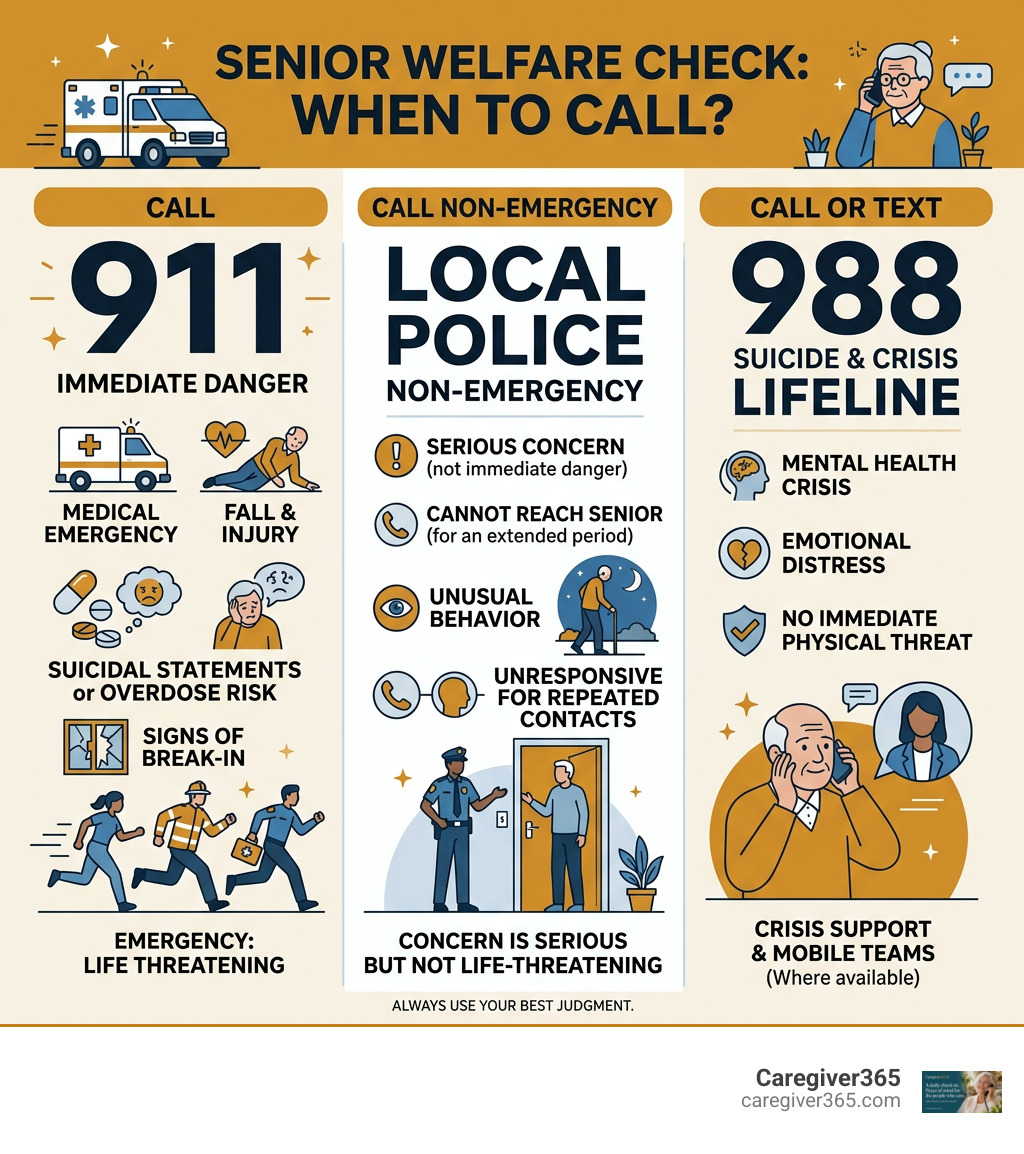
Do not wait for a family meeting during a medical emergency. Call 911 when immediate emergency help is needed.

Put the Next Step in Writing

Start with a plan for the next week: one priority your parent has identified, the tasks that support it, the person responsible for each task, and a review date. You do not need perfect agreement about everything to make one useful commitment. The next conversation can begin with what worked, what did not, and what needs to change.

Frequently Asked Questions

What can I do when my siblings will not help care for our parent?

Ask for a specific, manageable commitment rather than general help. Offer an option that fits their circumstances, including a task they can do remotely. When help is still unavailable, state your own limits and explore community or paid services. Do not build the care plan around promises nobody has made.

Should caregiving duties be divided equally among siblings?

Not necessarily. Aim for a sustainable arrangement based on availability, skills, distance, and finances. Count planning, transportation, and administrative work as contributions, not just time spent visiting. Review the arrangement when your parent’s needs or a sibling’s circumstances change.

Does the sibling providing the most care get to make all the decisions?

Providing care does not automatically give someone legal authority over a parent’s medical treatment or finances. Your parent’s ability to decide, any valid decision-making documents, and applicable state law matter. Clarify authority with the appropriate professionals rather than treating caregiving hours or a family vote as the deciding factor.

What if we disagree about whether our parent needs more help?

Compare concrete observations and include your parent’s perspective. Ask the care team which concerns need an assessment, then discuss options that address the identified needs. For a nonurgent decision, agree on what you will try, what you will watch for, and when you will review the plan.
Automated Peace of Mind for Caregivers and Seniors

Automated Peace of Mind for Caregivers and Seniors

Free Daily Check-In Apps: Where to Start

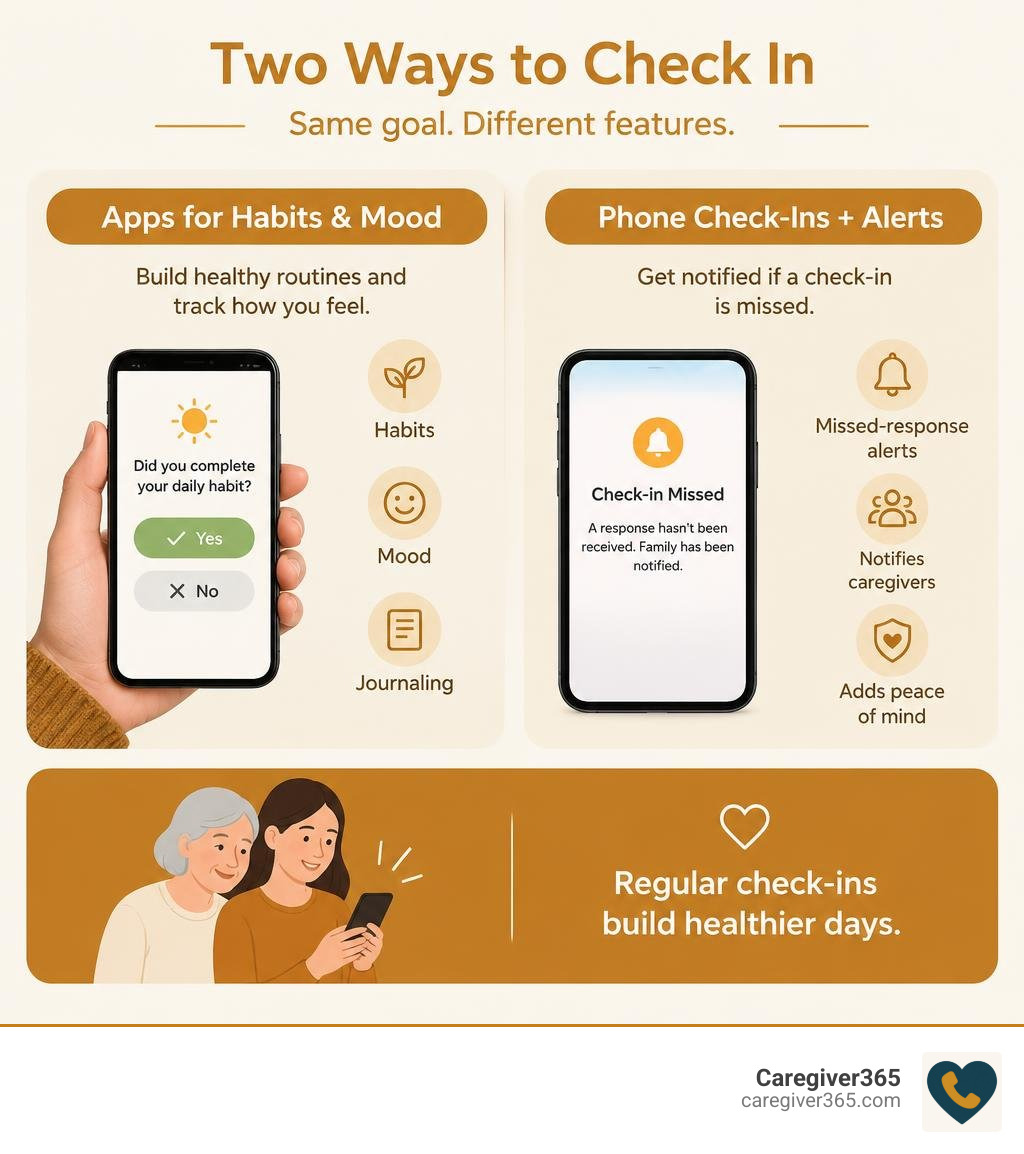
Looking for a free daily check-in option? Many families discover that a daily check-in app free of charge can log habits or moods, but it does not always notify loved ones when a senior misses a response. If your goal is caregiver safety, start by clarifying whether you need personal accountability or an automated call that can alert family after a missed check-in.

For a parent living alone, a completed check-in and a missed check-in are different needs. A mood or habit log can help build a routine, but it does not always alert family when someone fails to respond. If that alert is what you need, choose a tool that clearly explains how it contacts caregivers after a missed check-in.

comparison of free check-in apps for habits and mood versus phone check-ins with missed-response alerts infographic

Daily check-in app free terms to know:

For a broader look at how routine check-ins support independent living, the National Institute on Aging explains aging in place and home safety.

Free Check-In Tools for Senior Safety

Building consistent daily routines is one of the most effective ways to preserve independence while protecting health. When older adults maintain structured schedules—waking, taking medication, hydrating, and checking in—it provides a clear window into their overall well-being. Understanding why it is important to check in on seniors daily helps families detect gradual declines in physical health or cognitive sharpness long before a crisis occurs.

senior smiling while tapping a daily morning check-in reminder on a tablet

Mobile check-in utilities serve different purposes. Habit-tracking applications focus on personal accountability, encouraging users to log routines and journal reflections. Meanwhile, safety-focused check-in platforms establish reliable contact between seniors and their loved ones. Integrating a simple morning confirmation into a daily routine provides peace of mind without intruding on an individual’s privacy or autonomy.

Automated Phone Check-Ins for Aging in Place

Most older adults want to remain in their own homes as they grow older. However, successful aging in place requires safety nets that operate without constant friction. While smartphone apps work well for tech-savvy individuals, they often fall short for seniors who find touchscreens frustrating, forget to charge their devices, or misplace their phones around the house.

This is where automated check-in systems step in. Instead of requiring a senior to unlock an app and navigate menus, automated calling services place an outbound phone call at a scheduled time each day. The senior simply picks up any standard landline or mobile phone and presses a single button to confirm they are safe.

If the call goes unanswered, the system escalates the notification. Exploring how caregiver apps keep families in the loop shows the value of multi-contact notifications: when a check-in is missed, multiple family members or neighbors receive immediate alerts, enabling quick intervention.

What to Expect from a Daily Check-In Service

Many families begin with a daily check-in app free of charge, only to realize it does not replace caregiver alerts. Some app-based tools focus on personal habit or mood tracking, while safety-focused services actively check on a person and alert caregivers when no response arrives. Reviewing what each option delivers helps you pick the right tool for personal wellness or family safety.

Feature Automated Phone Check-In Services
Primary Platform Any Landline or Mobile Phone
Cost Structure Low-cost automated safety plans
Caregiver Escalation Automated calls and SMS to a Care Circle
Hardware Required Any phone (no apps, Wi-Fi, or charging needed)
Streak & Habit Tracking Focuses on safety verification and routine logs
Crisis Intervention Escalates unanswered calls directly to family

For families exploring budget-friendly safety options, learning about free daily check-in calls for seniors and how families can access them helps clarify the distinction between self-guided mobile apps and community-backed call systems.

Why a Free App Tier May Not Be Enough

A daily check-in app free tier may track a habit or mood, but it usually does not verify an older adult’s physical safety or automatically notify a family care circle. Automated phone check-in services call at a scheduled time and require only a one-button confirmation. If the call goes unanswered, the system retries and then escalates to designated family members.

Before choosing any service, review what is included without a paid upgrade. A reliable check-in service should offer scheduled outreach, retries after a missed call, and direct notifications to family members—not just an activity log.

Data Privacy, Security, and Offline Reliability

When logging daily habits, emotional states, or physical well-being, data privacy is paramount. Free applications handle user information in diverse ways, ranging from zero-telemetry local storage to encrypted cloud synchronization.

data privacy and security dashboard with encryption lock icons

Local Storage and Offline Logging

Many users prioritize tools that operate entirely offline without requiring account creation. Apps designed with an offline-first architecture store all responses, streak counters, and logs directly on the smartphone’s internal memory.

This approach offers distinct advantages:

  • Zero Account Requirements: You never have to hand over an email address, phone number, or name.
  • Offline Functionality: The app works flawlessly in airplane mode, during internet outages, or in rural areas with poor cellular reception.
  • No Third-Party Data Sharing: Because no data is sent to external cloud servers, your daily habits remain confidential.

How to Evaluate a Daily Check-In App Free of Data Privacy Risks

Before installing any wellness or check-in tool, take a few minutes to review its privacy practices:

  • Check Data Safety Disclosures: Review the App Store or Google Play data safety sections to verify whether information is linked to your identity or shared with third-party advertisers.
  • Look for End-to-End Encryption: If the tool features cloud synchronization or AI-assisted coaching, confirm that your logs are encrypted per user.
  • Examine Contact Permissions: Safety-focused tools that send crisis alerts should only access designated emergency contacts rather than copying your entire address book.
  • Demand Medical Disclaimers: Legitimate mental health and wellness applications clearly state that automated check-ins do not replace professional medical care or 911 emergency services.

Consistency and Emergency Escalation

Building a habit requires balancing daily momentum with grace for missed days. Traditional habit trackers often punish users by wiping out weeks of progress after a single missed day. Modern tools take a healthier approach:

  • Forgiving Streaks: Some platforms allow users to slip up without losing overall progress, treating consistency as a long-term journey rather than an all-or-nothing game.
  • Cooldown Windows: Some apps use a 16-hour cooldown cycle rather than a rigid midnight reset, accommodating early risers and night owls alike.

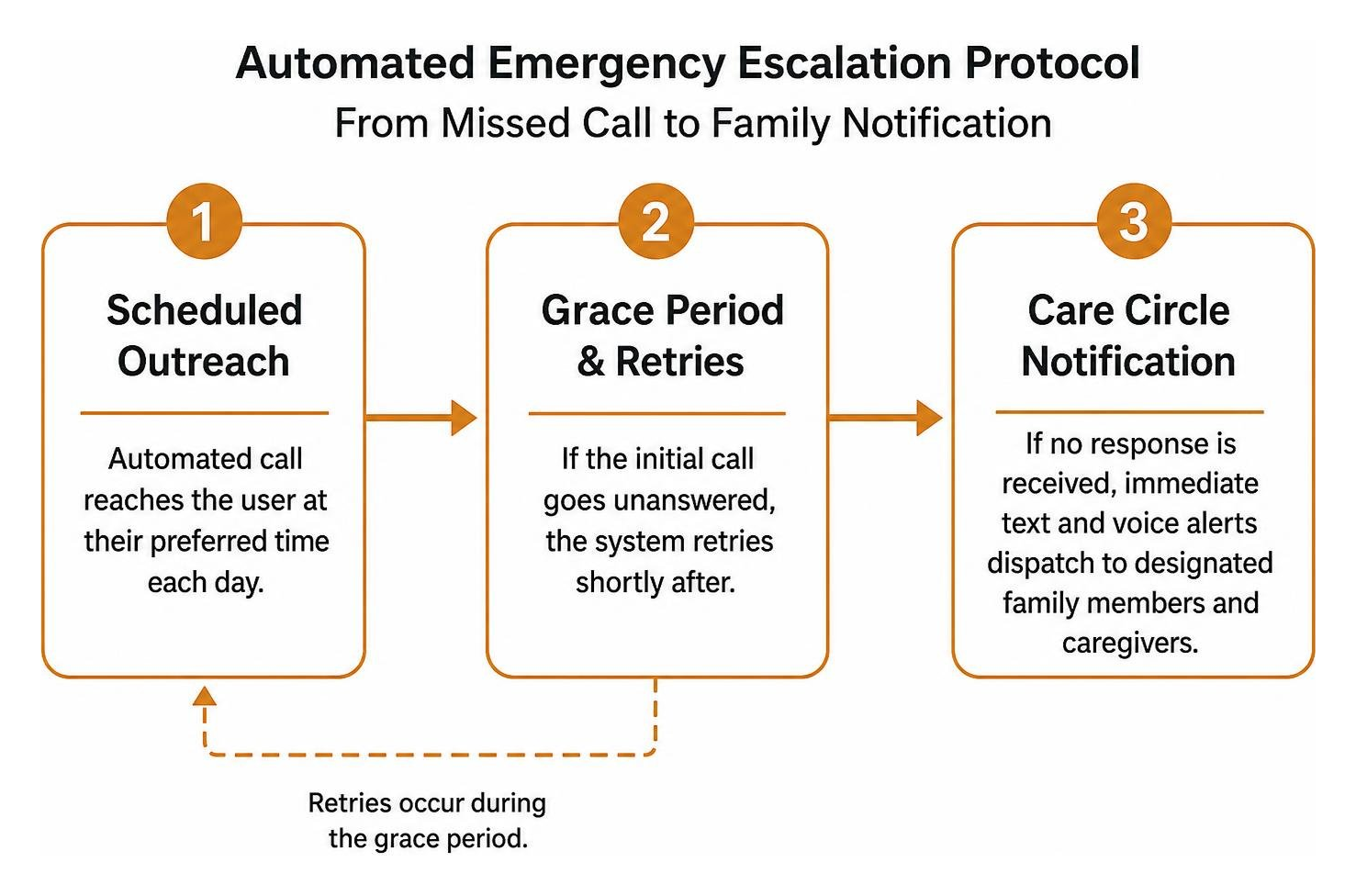
However, when tracking senior safety, a missed check-in cannot simply be treated as a broken habit streak. It must trigger a responsive safety sequence.

automated emergency escalation protocol from missed call to family notification

When evaluating automated check-in safety workflows, look for these critical steps:

  1. Scheduled Outreach: An automated call reaches the user at their preferred time each day.
  2. Grace Period & Retries: If the initial call goes unanswered, the system retries shortly after to rule out temporary distractions.
  3. Care Circle Notification: If no response is received, immediate text and voice alerts dispatch to designated family members and caregivers.
  4. Direct Verification: Family members check in directly or dispatch local assistance to verify safety.

Missed Check-In Escalation and Medical Alert Integration

Families frequently ask how daily check-in services work alongside medical alert systems. Understanding the trade-offs between check-in calls vs a medical alert button helps clarify why proactive outreach is essential.

A medical alert device is one part of a safety plan, but it is often reactive. Caregiver365 complements medical alert systems by adding a proactive daily check-in call. If a senior falls, suffers a stroke, or leaves the device on the nightstand, the missed call still triggers an alert. Automated daily check-in calls require an active response every morning, so they can uncover emergencies even if the individual cannot reach a phone.

Frequently Asked Questions About Daily Check-In Tools

Can check-in tools operate entirely offline without internet?

Some mobile check-in tools can store logs locally without an internet connection, but they usually cannot alert caregivers when no response arrives. Safety-focused services that notify family members require active cellular or Wi-Fi connectivity to transmit alerts.

How do check-in tools notify family members if an update is missed?

Mobile apps may rely on device-level push notifications or automated SMS triggers sent to pre-selected contacts. Dedicated safety services run automated server-side calling workflows. If an outbound check-in call is not acknowledged, the platform automatically calls and texts a multi-member Care Circle until someone confirms the senior’s safety.

What are the main limitations of smartphone check-in apps for older adults?

Smartphone check-in apps require regular device charging, reliable Wi-Fi or data plans, screen navigation skills, and remembering to open the app each day. For seniors with arthritis, vision loss, or mild cognitive impairment, smartphone apps can introduce confusion. Automated phone-call check-in services solve this problem by working on any existing landline or basic mobile phone with zero app downloads or touchscreen use required.

Conclusion

Daily check-ins build consistency and peace of mind, especially when an older parent lives alone. Rather than relying on a self-guided mobile habit log, families can use phone-based check-in systems that actively verify safety.

Caregiver365 delivers automated daily phone calls to seniors on any landline or cellular device—no apps, wearable pendants, or Wi-Fi setup needed. With support for up to eight Care Circle contacts and seamless medical alert integration, families stay informed every single morning. Discover how daily check-in calls work to ensure your loved ones remain safe, connected, and independent at home.

Modern Remote Health Monitoring: The Non-Intrusive Caregiver Advantage

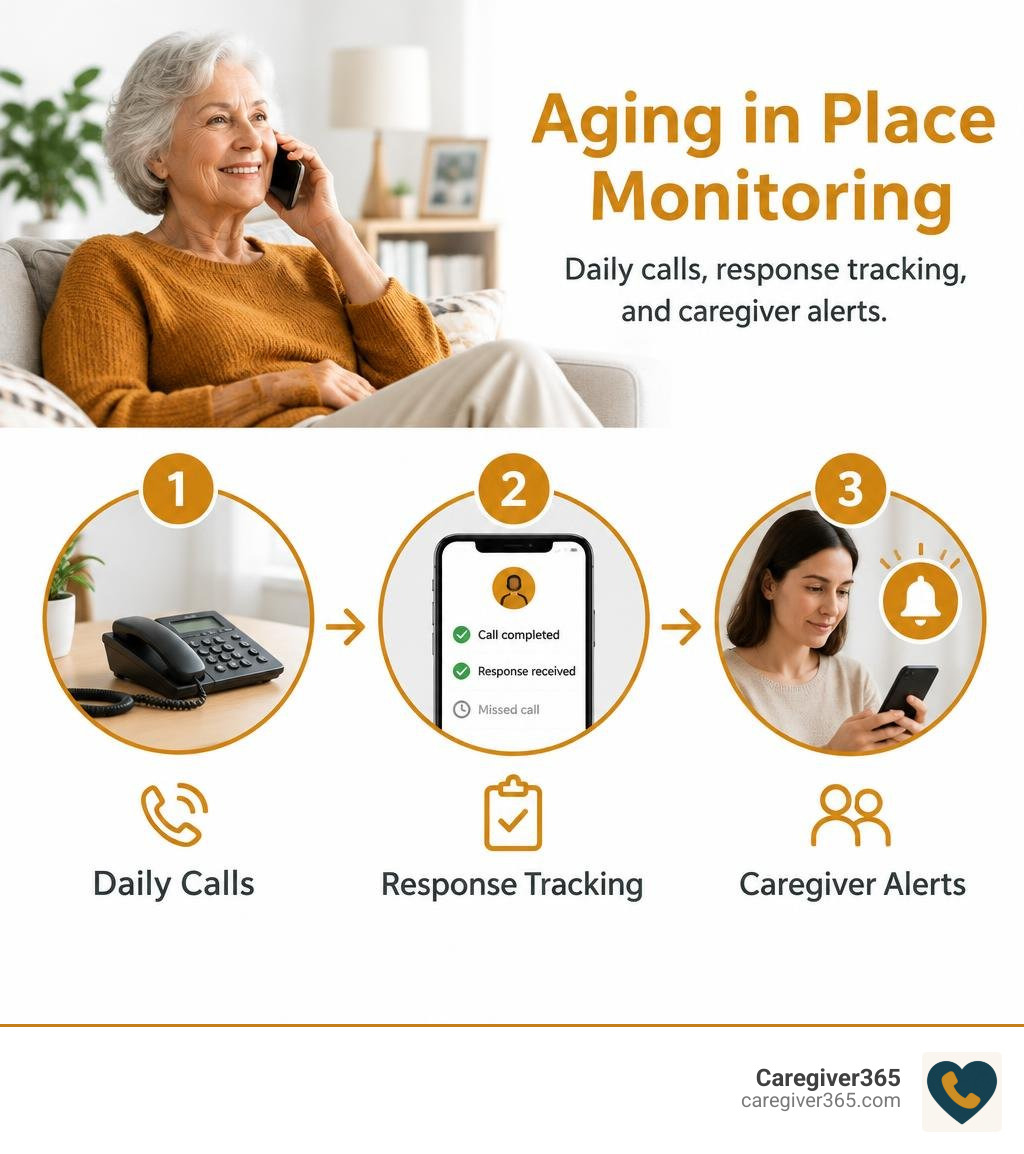
Aging in Place Monitoring with Daily Phone Check-Ins

Start with a daily phone check-in your parent agrees to. Choose a time they can expect, decide who gets an alert if they do not answer, and make a plan for what that person will do next. A missed call is a reason to check in, not proof of an emergency.

Effective aging in place monitoring gives someone living alone a simple way to confirm they are okay through a familiar daily call. Automated check-ins provide an effortless routine that fits naturally into a family’s existing support plan. If their health changes, you can adjust the check-in schedule together. It supports independence while giving family a clear next step when a call goes unanswered.

Daily calls, response tracking, and caregiver alerts for aging in place monitoring infographic

As of October 2026, 17.3% of the U.S. population is 65 and older (57.8 million individuals), and demographic trends indicate that 1 in 5 Americans will be 65 or older by 2030. Looking further ahead to 2050, that figure will reach 23%—roughly 82 million adults. Research shows that 77% of adults aged 50 and older want to remain in their homes for the long term.

However, only 10% of U.S. homes are currently equipped to accommodate aging adults, and one-third of adults over 50 recognize the need to modify their living environment. While investments in structural safety have a proven return—yielding $1.50 in reduced medical spending for every $1 invested for adults 75 and older—physical modifications only solve part of the equation. A dependable daily routine can help families stay connected without adding complicated equipment, ongoing maintenance, or privacy concerns.

How Scheduled Check-Ins Support Aging in Place

Families often need a reliable way to know when an older adult has started the day safely, especially when loved ones live separately. A simple scheduled check-in creates a predictable routine without requiring a complicated setup.

older adult answering a phone at home

Scheduled phone check-ins fit into an older adult’s existing day-to-day routine rather than demanding continuous technical management. Exploring senior safety options can help families choose a practical approach that respects independence.

Understanding Non-Intrusive Check-In Options

Automated phone-based systems offer a practical, frictionless way to establish a daily safety routine. Calls reach seniors on their everyday landline or mobile device at a pre-selected time.

When the senior answers and confirms their status by pressing a single key, their safety circle receives peace of mind for the day. If a call is missed after repeated attempts, the system automatically alerts the designated family “Care Circle” of up to eight members, enabling immediate follow-up without relying on third-party call centers.

Addressing Privacy Concerns with Familiar Technology

A critical obstacle to home technology adoption is the fear of constant surveillance. Some older adults may be reluctant to adopt technology that feels intrusive or difficult to manage.

A scheduled phone call can support dignity and personal autonomy by using a familiar form of communication. Phone-based check-ins require no Wi-Fi setup or home modifications.

How Health Status Influences Acceptance and Check-In Plans

Acceptance of home safety technology is not static; it fluctuates directly with an older adult’s perceived health needs.

A study on passive home health monitoring revealed that older adults’ comfort with safety systems increases significantly when they are home alone (Odds Ratio = 1.46; p = 0.012) and rises even more when they are sick or recovering from an illness (OR = 2.21; p < 0.001).

When health status declines, families can combine proactive environmental steps—such as applying room-by-room fall prevention strategies—with increased check-in touchpoints.

Adjusting Check-Ins as Needs Change

A family’s check-in plan can change as an older adult’s needs change. During illness or recovery, a temporary increase in call frequency may provide reassurance and prompt follow-up when a scheduled call goes unanswered.

Scheduled telephone check-ins work wherever the older adult can answer their landline or mobile phone. This familiar routine offers a straightforward way to confirm well-being and support daily living routines without changing the home environment.

Data Sharing Preferences Across Care Circles

Older adults are selective regarding who sees their daily activity patterns. Data indicates that seniors are most willing to share wellness information on a regular basis with:

  1. Family Members: 81% willingness
  2. Healthcare Providers: 80% willingness

Willingness to share data increases to 71% across other secondary support networks during acute illness. Understanding the core reasons to check in regularly helps families establish transparent communication boundaries, ensuring older adults feel supported rather than scrutinized.

How to Implement an Unobtrusive In-Home Monitoring Plan

Establishing a dependable safety network does not require complicated technical installations or expensive contractors.

By following the systematic process outlined in how daily check-in calls work, families can deploy a comprehensive plan in four simple steps:

  1. Establish a Predictable Call Window: Select a daily time slot aligned with the senior’s natural routine (e.g., 9:00 AM after morning tea).
  2. Set Up the Contact Chain: Designate up to eight family members, trusted neighbors, or primary caregivers within the Care Circle who receive notifications.
  3. Define an Escalation Protocol: Agree on immediate verification steps if a check-in is missed (e.g., primary contact calls back, secondary contact visits the residence).
  4. Review the Plan Regularly: Revisit the call schedule and contact chain whenever health needs or family availability changes.

Designing Flexible Aging in Place Monitoring for Changing Health Needs

Health trajectories change over time. A senior managing seasonal flu or recovering from outpatient surgery may require two to three daily check-ins (morning, midday, and evening). Once baseline mobility returns, the schedule can adjust back to a single morning call. Because telephone check-in services require no physical hardware adjustments, these transitions occur seamlessly through software settings without disturbing the home environment.

Balancing Automated Checks and Direct Family Support

While automated services ensure consistent daily contact, they are designed to support personal family relationships, not replace them. Automated check-ins handle routine verification, removing the daily friction of “checking up” on aging parents and reducing caregiver burnout.

When an unexplained absence or missed call pattern emerges, family members can follow the escalation steps they agreed on in advance, such as calling back or asking a trusted local contact to check in or reviewing when further assistance may be needed.

Frequently Asked Questions About Home Health Monitoring

How do daily phone check-ins support independent living?

Daily automated check-ins give older adults a simple, predictable way to confirm they are okay. A comparison of check-in approaches can help families understand how a scheduled call supports their daily plan. When a scheduled call goes unanswered, the designated Care Circle receives an alert and can follow the family’s agreed follow-up plan.

What are the biggest privacy barriers for seniors adopting home monitoring?

The primary barriers are concerns about privacy, complicated technology, and losing independence. Voice-based phone check-ins use familiar household technology and give older adults a straightforward way to participate in their own daily safety routine.

How do check-in needs change when an older adult becomes ill?

During illness or post-hospitalization recovery, fall risks and sudden health declines increase significantly. Studies show older adults are over three times more receptive to heightened monitoring during these periods. Families can temporarily increase daily check-in frequencies to provide closer oversight, returning to standard once-daily schedules once health stabilizes.

Conclusion: Empowering Independence with Non-Intrusive Care

Seniors do not have to choose between their personal independence and their family’s peace of mind. By leveraging simple, privacy-preserving solutions, families can create a dependable safety network without adding complicated technology to the home.

Explore how automated daily phone check-ins provide continuous care circle awareness while preserving the comfort, autonomy, and dignity of aging in place.

References

Kim D, Bian H, Chang CK, Dong L, Margrett J. “In-Home Monitoring Technology for Aging in Place: Scoping Review..” Interactive journal of medical research, 2022. PMID 36048502.

Free Daily Check In Calls for Seniors and How Families Can Access Them

Find Free Daily Check In Calls for Seniors Near You


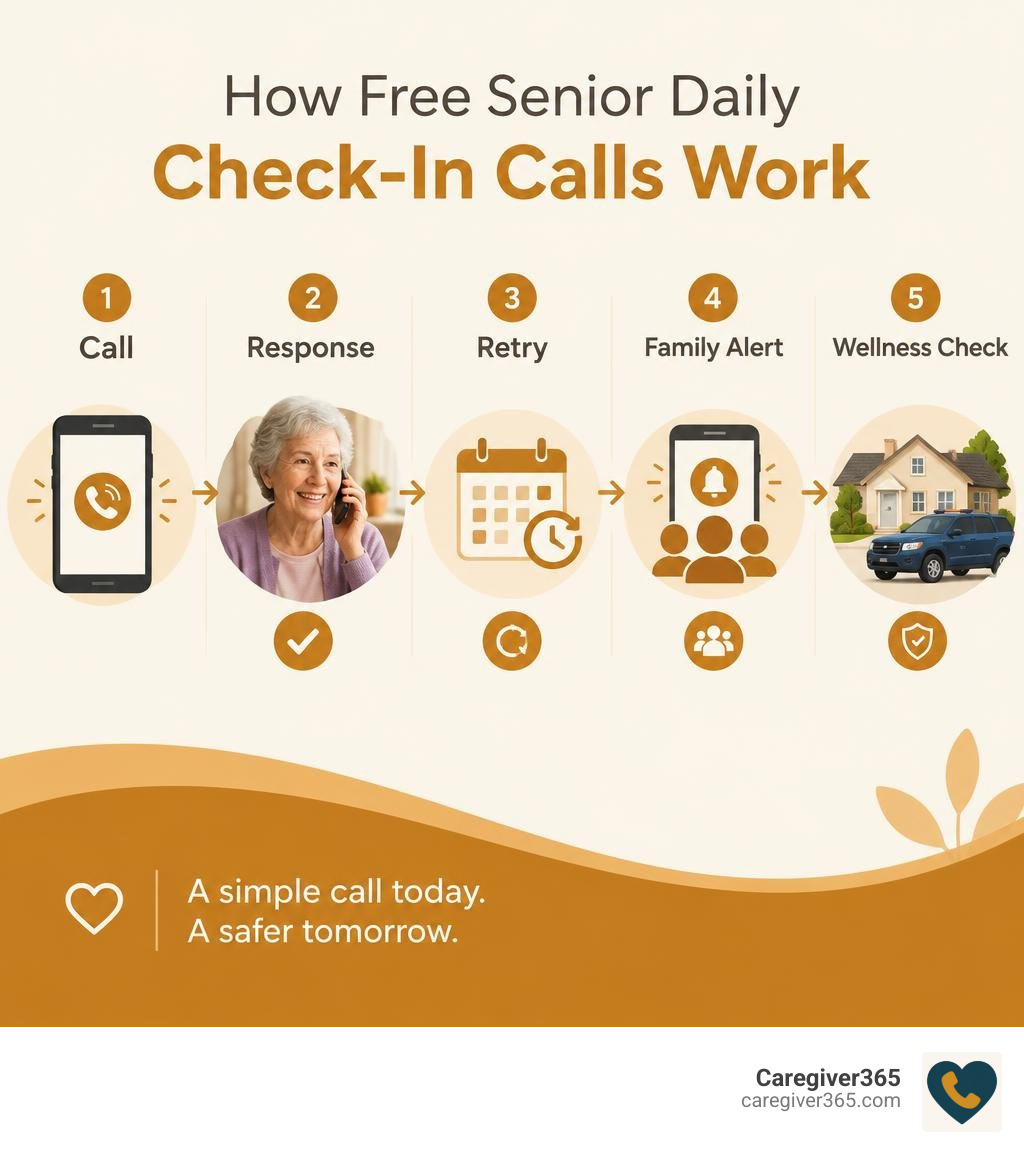
Free daily check in calls for seniors may be available through local police or sheriff’s departments, county aging offices, state programs, and community senior services. Start by calling your local police department’s non-emergency number or your Area Agency on Aging to ask whether they offer a telephone reassurance program.

These programs usually place an automated call at a scheduled time. If your parent does not answer after the program’s retry process, the service may alert listed family contacts and, in some communities, arrange a wellness check.

For families, this can be a simple safety net for an older adult who lives alone, especially when everyone cannot call every day. It is not a replacement for 911 or a medical alert device during an active emergency. But it can help ensure a missed call does not go unnoticed for too long. According to the National Institute on Aging, regular social contact and safety monitoring can support older adults who wish to remain independent at home.

How free senior daily check-in calls work: call, response, retry, family alert, wellness check infographic

Handy free daily check in calls for seniors terms:

Types of Free Daily Check In Calls for Seniors Available Today

With approximately 14 million seniors living alone across the United States, maintaining a reliable daily connection is one of the most effective ways to preserve independence while protecting personal safety. It helps to understand why it is important to check in on seniors every single day: a quick morning confirmation bridges the gap between total independence and emergency isolation.

Not all phone programs operate the same way. Some prioritize emergency safety escalation, while others focus on easing loneliness through casual conversation.

Program Type Primary Goal Delivery Method Escalation Workflow Best Suited For
County Reassurance Programs Safety & rapid emergency response Automated phone calls Retries, alerts family, dispatches local police if needed Seniors living alone without nearby family
State Aging Initiatives Daily safety confirmation Automated interactive voice response Notifies designated family or community liaisons Solo agers in participating state regions
Volunteer Companionship Social connection & emotional wellness Live volunteer phone chats Reaches out to alternate contacts if calls go unanswered Older adults seeking conversation and friendship

Local Public Check-In Programs

Across hundreds of counties nationwide, municipal police departments and sheriff’s offices manage dedicated telephone reassurance initiatives. These municipal programs are specifically designed to confirm that an older adult is up and moving each morning.

Understanding how daily check-in calls work at the local level is straightforward. The department’s computerized calling system rings the senior’s landline or mobile phone at a predetermined time each morning. The senior answers and presses a designated key on their telephone keypad (such as “1”) to confirm they are safe. If the phone rings without an answer, the automated system enters a built-in retry window before escalating the alert to listed family contacts or dispatching a community officer for an in-person safety check.

State and Area Agency on Aging Programs

Several state governments and regional Area Agencies on Aging sponsor automated reassurance check-ins funded by public health grants. For example, states like Maryland and Ohio have established statewide telephone check-in programs tailored to independent seniors.

These programs deliver an automated check-in call every morning at a scheduled time selected by the participant. If the individual confirms their well-being, the call concludes in seconds. If the participant cannot be reached after several automated retry attempts, the program automatically alerts designated family members, neighbors, or local senior social workers.

Volunteer Social Call Services

Volunteer phone companion programs focus primarily on relieving social isolation rather than active emergency dispatch. Community organizations and non-profit groups pair older adults with trained volunteers who place friendly, regular phone calls to chat about daily routines, hobbies, and current events.

While these warm conversations provide immense emotional value and companionship, families should remember that volunteer lines generally do not feature automated multi-contact emergency escalation protocols. They serve as a wonderful layer of social support alongside a structured safety check-in routine.

How to Find and Set Up Free Check-In Call Programs

daughter helping senior parent set up emergency contacts

Locating a no-cost telephone reassurance program in your area takes just a few targeted inquiries. Because these services are organized locally, availability depends on your county, municipality, or state of residence.

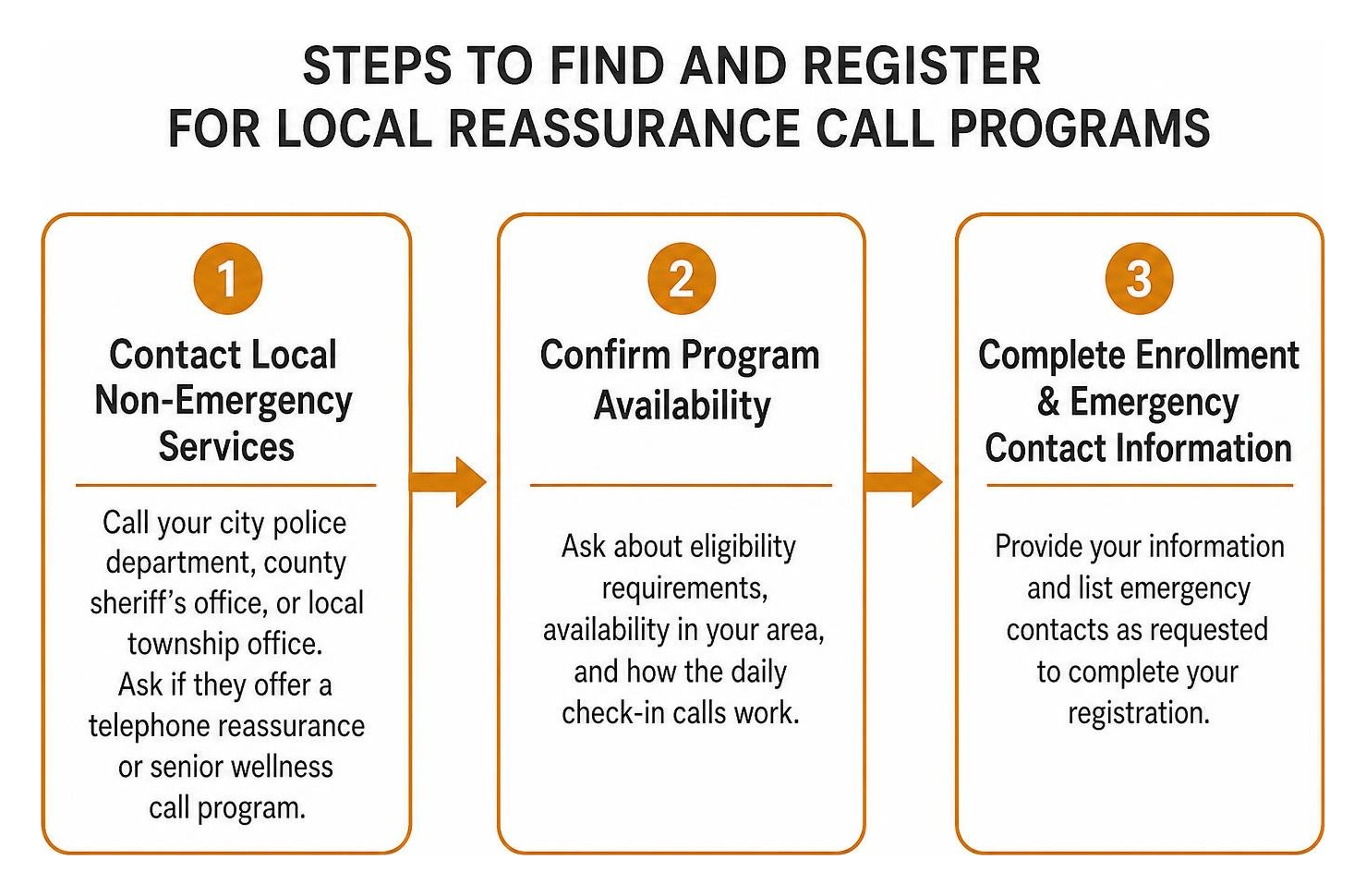
Steps to find and register for local reassurance call programs

How to Sign Up for Free Daily Check In Calls for Seniors via Local Services

To establish free reassurance calls through a local municipal agency, follow these practical steps:

  1. Contact Your Local Non-Emergency Services: Call the non-emergency administrative phone line of your city police department, county sheriff’s office, or local township office. Ask directly if they maintain a telephone reassurance or senior wellness call roster.
  2. Consult Your Area Agency on Aging: Call the Eldercare Locator at 1-800-677-1116 to connect with your regional Area Agency on Aging. Ask their resource coordinators for any government-funded daily check-in call initiatives active in your zip code.
  3. Complete the Intake Application: When registering, you will provide essential details, including preferred daily call times, primary phone numbers (landline or cell), medical conditions, lockbox codes, and emergency keyholder contact numbers. If an unreturned call ever requires an in-person follow-up, having this information on file helps first responders. Reviewing our practical guide to requesting a senior welfare check online or by phone will give your family clear insight into how local agencies carry out these safety visits.

Key Features to Configure for Maximum Senior Safety

When setting up any daily check-in routine, families should configure the alert system to minimize false alarms while maintaining a reliable safety net. As detailed in our definitive guide to senior safety solutions, a structured escalation plan prevents missed calls from spiraling into unnecessary panic.

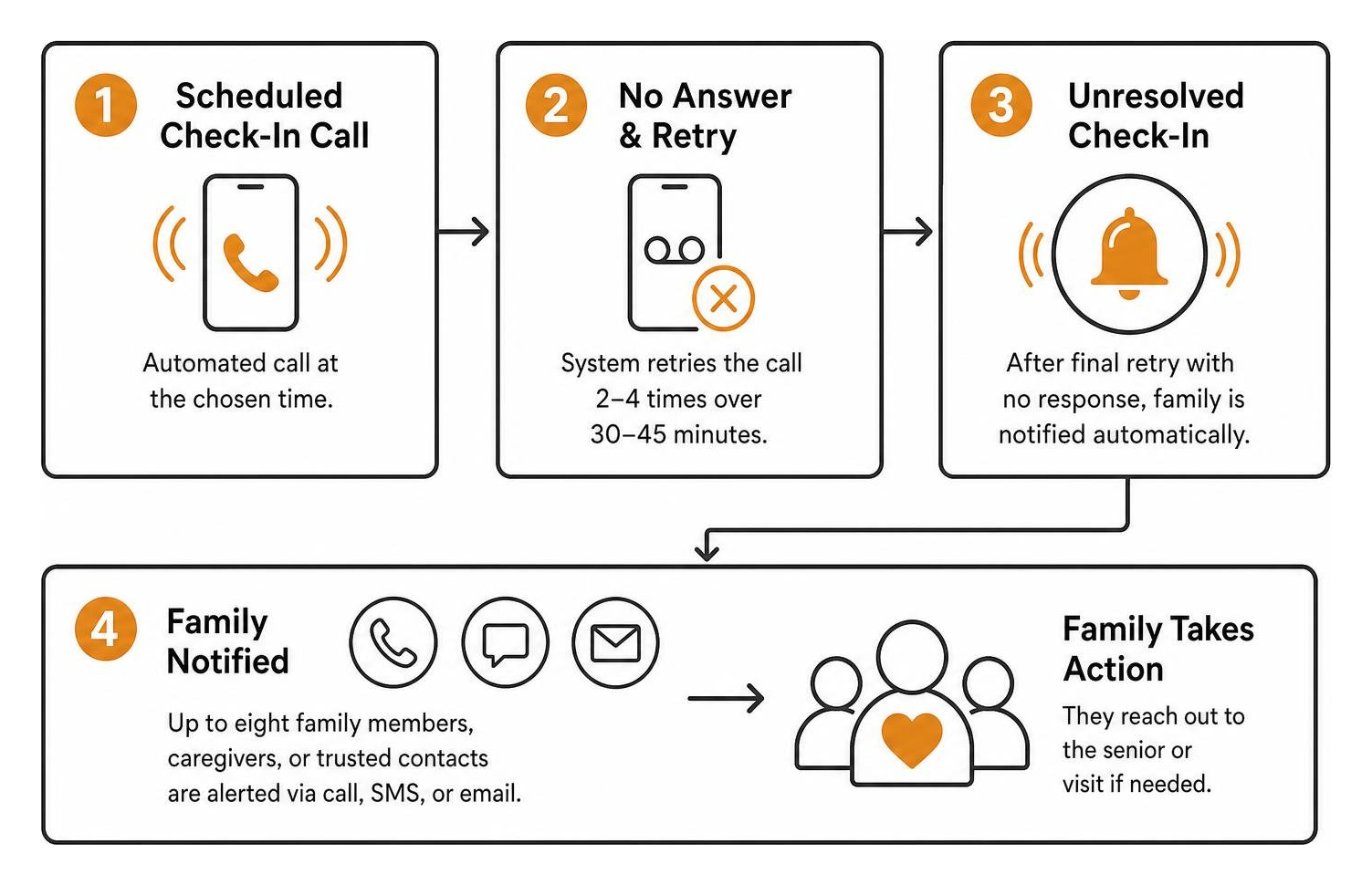
  • Reasonable Call Retry Intervals: Make sure the system is configured to place 2 to 4 automated retry attempts across a 30-to-45-minute window before triggering emergency alerts. This gives your loved one time to finish a shower or step inside from watering the garden.
  • Tiered Family Care Circles: Establish an escalation sequence that contacts primary family caregivers first via automated calls or text notifications before alerting secondary neighbors or local authorities.
  • Consistent Scheduling: Align the daily check-in call with your parent’s natural morning routine, such as right after their morning coffee or breakfast.

Daily Check-In Calls and Emergency Response

senior answering a traditional home telephone

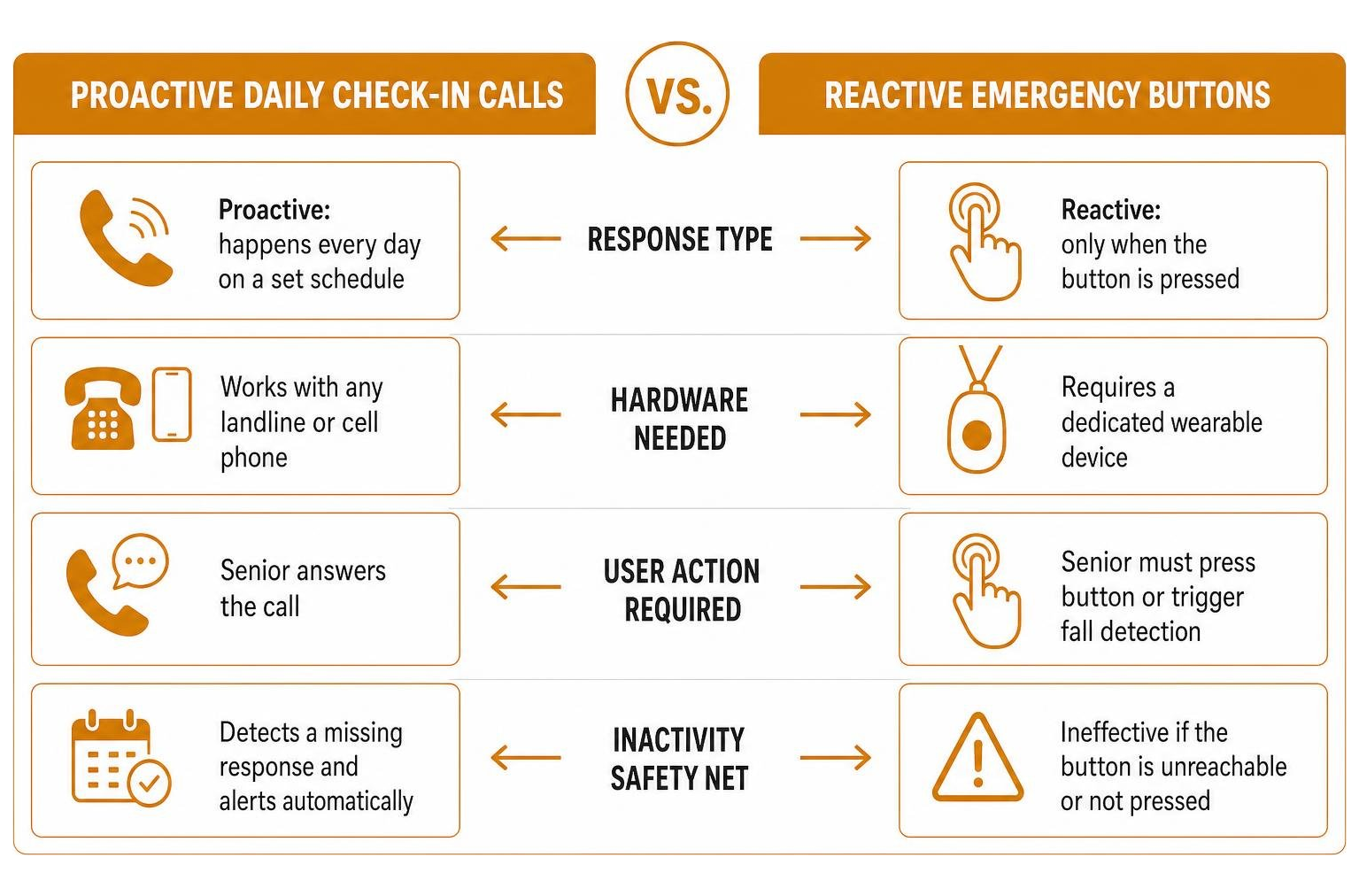
A frequent question families ask is whether daily check-in calls replace wearable emergency pendants or 24/7 medical alert buttons. While both tools protect independent seniors, they serve distinct and complementary roles in a comprehensive care plan.

Comparison between proactive daily calls and reactive emergency buttons

Medical alert systems are reactive: they require the individual to manually push a button or depend on automatic fall-detection sensors that can sometimes fail or be left on a nightstand. Daily automated check-in calls are proactive. They verify wellness on a fixed schedule every single day without requiring the senior to wear special hardware or remember charging cables.

To review an in-depth breakdown of how these technologies work together, explore our comparison on check-in calls vs a medical alert button.

Exploring Caregiver365 Automated Daily Monitoring

While free public programs provide an essential service, municipal coverage is not available in every county or township. When local agencies do not offer a reassurance service, or when families want greater flexibility, customization, and control, automated daily monitoring services fill the gap seamlessly.

At Caregiver365, we provide an automated daily phone check-in service built specifically to support independent seniors and give remote families complete peace of mind:

  • Works on Any Phone: Our system works on standard landlines, flip phones, or smartphones with no hardware installation, Wi-Fi setups, or app downloads required for the senior.
  • Expanded Care Circle: We notify up to eight family members, trusted neighbors, or caregivers simultaneously via automated calls, SMS messages, or email the moment a morning check-in is successfully completed or missed.
  • Medical Alert Integration: Our platform integrates seamlessly alongside existing medical alert devices, providing an automated daily safety net that checks in even if a pendant is left on the dresser.
  • Effortless Senior Interaction: Seniors simply answer the phone at their chosen time, listen to our friendly automated greeting, and press “1” to confirm they are doing well.

Learn more about how it works and see how simple daily safety monitoring can be for your family.

What to Do When Free Daily Check In Calls for Seniors Are Unavailable in Your Area

If your local police department or Area Agency on Aging does not operate a free phone reassurance program, your family can implement a reliable daily check-in routine using several straightforward approaches:

  1. Establish a Family Check-In Rotation: Divide daily morning check-in duties among siblings or extended family members. Assign specific days of the week to each person to ensure your loved one receives a daily phone call or text confirmation at a consistent time.
  2. Coordinate with Trusted Neighbors: Arrange a daily visual signal with a nearby neighbor, such as opening the front window blinds by 9:00 AM or retrieving the morning newspaper. If the blinds remain closed, the neighbor checks in directly.
  3. Use an Automated Reassurance Service: If busy work schedules or time zones make daily manual calling difficult, an automated check-in service like Caregiver365 ensures your parent receives their safety call every single day without fail, instantly looping your entire family into the results.

Frequently Asked Questions About Senior Check-In Calls

What happens if a senior misses a scheduled daily check-in call?

When an automated check-in call is not answered, the system does not immediately sound an alarm. Instead, it initiates a series of automatic retry calls over a set timeframe (usually 2 to 4 calls spaced 10 to 15 minutes apart). If the senior still does not answer after the final retry attempt, the system automatically alerts the designated family members in their Care Circle via phone call, text, or email so they can reach out directly.

Automated escalation flow from missed call to family notification

Can a senior use a free check-in call service on a traditional landline?

Yes. The vast majority of municipal telephone reassurance programs and automated services operate over standard landline telephone connections as well as cellular phones. The senior only needs to pick up the handset when the phone rings and press a single number on their telephone keypad to confirm they are safe.

How do free community calls differ from automated safety check-in calls?

Free volunteer companionship calls focus on social engagement, conversation, and combating senior loneliness. These calls are typically scheduled once or twice a week and last between 15 and 30 minutes. Automated safety check-in calls, by contrast, occur every day at a fixed time, take less than 15 seconds to complete, and feature structured escalation protocols that notify family caregivers if an individual does not respond.

Conclusion

Aging independently at home is a goal shared by millions of older adults, and maintaining a consistent daily connection is key to making that possible. Whether you enroll in a free telephone reassurance program through your local police department, participate in a state aging initiative, or set up an automated calling platform, establishing a dependable daily check-in brings reassurance to older adults and their families.

Take a moment today to explore the reassurance services available in your parent’s community, or explore how daily check-in calls work to discover how simple it is to build a reliable safety circle for your family.

Why It’s Important to Check in on Seniors

Checking In on Seniors: Why Daily Contact Matters

Quick answer: Checking in on seniors reduces isolation, helps catch health problems early, and gives families peace of mind. Daily contact does not have to mean daily phone calls from a busy adult child. Automated senior check-in services, like Caregiver365’s daily call, confirm a loved one is safe without requiring new devices, apps, or a change in routine.

For families with aging parents, a daily hello can mean the difference between catching a problem early and finding out too late. Yet many caregivers already juggle jobs, kids, and their own households, making a daily phone call harder to keep up than it sounds.

This is where Caregiver365’s automated check-in solutions come in. They offer a consistent way to confirm a senior is okay, without asking anyone to learn new technology or change their phone.

Why Regular Check-Ins Matter for Senior Wellness

Consistent contact with family does more than offer comfort. It plays a real role in a senior’s health and happiness.

  • Reduced isolation. Frequent contact helps seniors feel less alone, which supports better mental health.
  • Early detection. A missed check-in can be the first sign that something is wrong, giving family a chance to respond quickly.
  • Better quality of life. Seniors who feel connected to their families tend to report a stronger sense of well-being.

Senior check-ins are not just a courtesy. They are a proactive way to catch small problems before they become emergencies.

Why Is It Hard to Stay Connected With Aging Parents?

Adult children want to check in on their parents every day, but life gets in the way.

  • Work schedules, childcare, and daily responsibilities leave little room for a consistent call.
  • Seniors themselves may forget to reach out, especially if memory or routine has started to slip.
  • Manual check-in systems, like a family calendar of who calls when, are hard to maintain and easy to let slide.

The result is a gap between the intention to check in on seniors regularly and the reality of a busy household.

How Do Automated Daily Check-In Calls Work?

Caregiver365’s daily check-in service closes that gap without adding complexity.

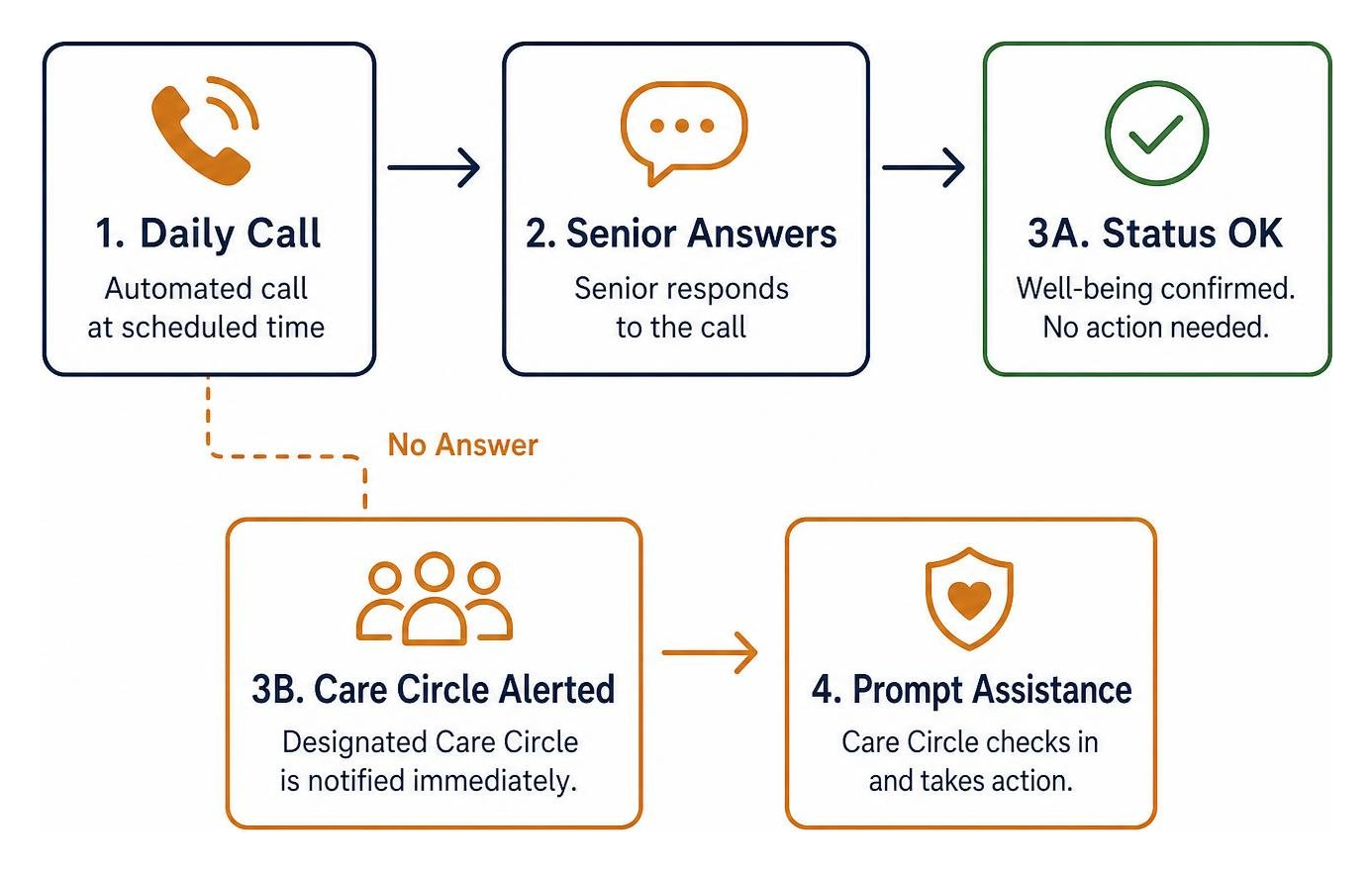
  1. A call arrives at a time the family chooses.
  2. The senior answers and presses 1 to confirm they are okay.
  3. If the call goes unanswered, the service retries several times over the following hour.
  4. If there is still no response, the senior’s Care Circle is notified by phone, text, or email.

No smartphone, app, or extra device is required. The service works on any landline or cell phone the senior already uses.

What Are the Benefits of Automated Check-In Services?

  • Consistency. A daily confirmation replaces the guesswork of “did anyone hear from Mom today?”
  • Less caregiver stress. Families gain reassurance without needing to make the call themselves.
  • Independence for seniors. A senior can continue living on their own terms while staying connected.
  • Faster alerts. If something seems wrong, family members are notified right away instead of finding out hours or days later.

How Do You Get Started With a Check-In Service?

Setting up senior check-ins through Caregiver365 involves a few simple choices:

  1. Pick a time of day that fits the senior’s routine.
  2. Add up to eight family members or friends to the Care Circle.
  3. Add optional reminders, such as medication alerts, to the daily call.
  4. Use the existing phone line at home. No new devices are needed.

Frequently Asked Questions

What is a senior check-in service?

A senior check-in service places an automated daily call to confirm an older adult is safe. If the call is missed, the service retries and then alerts a designated Care Circle.

Does a check-in service require a smartphone?

No. Caregiver365’s daily check-in call works on any landline or cell phone. No app or additional device is required.

What happens if my loved one misses the check-in call?

The service calls back several times over the following hour. If there is still no answer, family members in the Care Circle are notified by phone, text, or email.

How is a check-in call different from a medical alert button?

A check-in call is proactive, confirming a senior is okay each day. A medical alert button is reactive, used the moment an emergency happens. Many families use both together.

How many people can be added to a Care Circle?

Up to eight family members or friends can be added to receive alerts if a check-in is missed.

Make Checking In on Seniors Part of the Routine

Checking in on seniors is one of the simplest, most meaningful things a family can do. It will not prevent every problem, but it builds a daily habit of connection and catches issues before they grow.

Automated check-in services take the pressure off busy schedules while keeping that daily thread of contact intact. Caregiver365’s daily check-in call gives families a reliable way to confirm a loved one is safe, without adding another task to an already full day.

Ready to make senior check-ins easier for your family? Visit Caregiver365 to learn how the daily check-in call works and start protecting the people you care about most.

A Practical Guide to In-Person Welfare Checks for Aging Loved Ones

Senior Well-Being Checks: A Simple Way to Stay Ahead of Problems

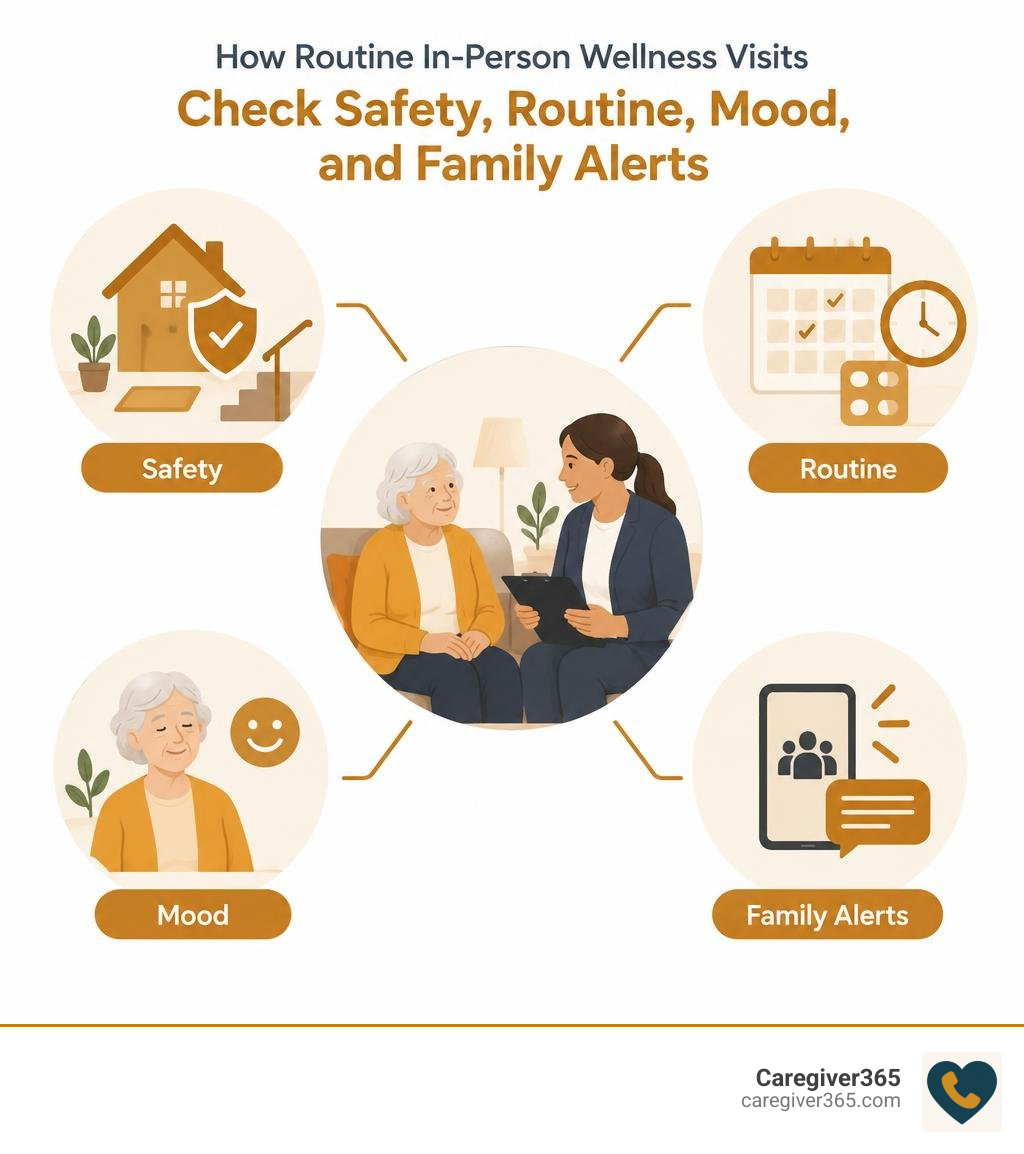
A senior well being check is a planned visit that confirms an older adult is safe, comfortable, and managing well at home. A trained visitor looks for changes in physical condition, mood, daily routine, and home safety, then shares concerns with the family or care circle.

For an adult child caring from a distance, these visits can provide practical reassurance without requiring your parent to learn new technology or wear another device. They can also spot small concerns – such as a trip hazard, missed medication routine, low food supplies, or unusual confusion – before they become a larger emergency.

Unlike a medical appointment, a non-medical well-being visit does not diagnose or treat illness. It adds a regular set of caring eyes and ears to support an aging loved one’s independence, especially when family cannot be there in person. According to the National Institute on Aging, regular social contact and home safety monitoring can help older adults remain independent longer.

How routine in-person wellness visits check safety, routine, mood, and family alerts infographic

Core Components of a Comprehensive Senior Well Being Check

When an older adult wishes to age in place, maintaining that independence requires proactive support. A comprehensive welfare visit evaluates several dimensions of daily living to build a clear, holistic picture of how a senior is managing.

Living room safety assessment for seniors

A thorough assessment typically includes:

  • Visual and Physical Observations: Visitors observe mobility, balance, personal grooming, and general physical vitality. Subtle changes—such as moving with hesitation, favoring one side, or wearing unwashed clothing—can indicate emerging physical limitations or fatigue.
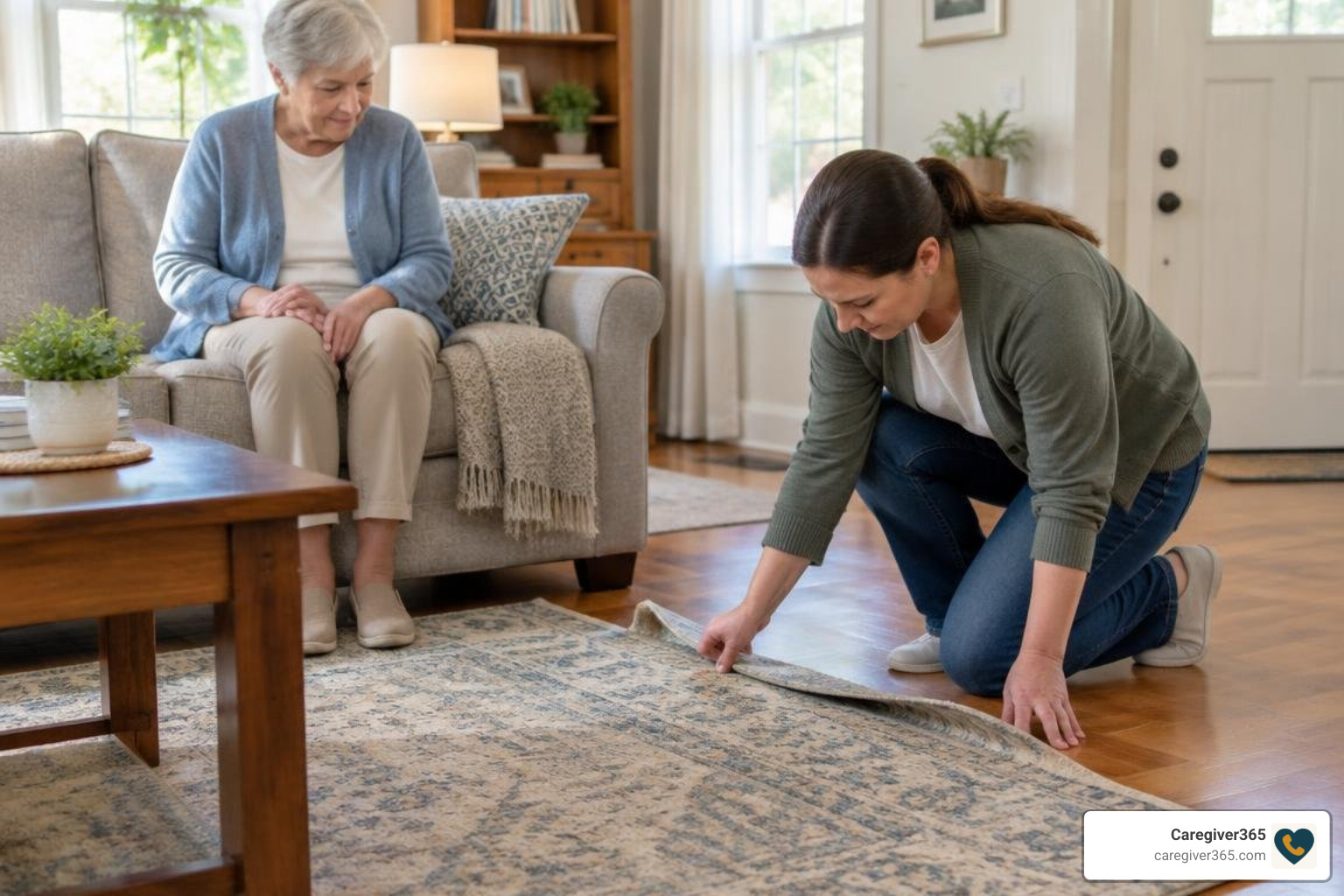
  • Living Environment and Fall Hazards: The visitor scans living areas for clear walkways, loose throw rugs, poor lighting, or cluttered hallways. As the adage goes, changing a burned-out lightbulb can be a truly heroic act when it keeps someone safely on their feet.
  • Emotional and Mental Status: Engaging in genuine conversation allows the visitor to assess mood, signs of withdrawal, emotional distress, or memory lapses. Sometimes a friendly chat about the morning weather reveals more about cognitive clarity than a rigid questionnaire.
  • Nutrition and Hydration Review: Checking the kitchen helps confirm that fresh food is available, expiration dates are current, and meals are being prepared consistently rather than skipped.
  • Medication and Routine Awareness: While non-medical personnel do not administer drugs, they can observe whether pillboxes are organized, prescriptions are being refilled, and daily routines are being followed smoothly.

Non-Medical Senior Well Being Check vs. Automated Check-Ins

Both in-person visits and automated monitoring tools play critical roles in modern senior care, yet they serve distinctly different needs.

In-person visits provide rich, qualitative context. A visitor can detect subtle odors, notice a stack of unopened mail, or see that a pet’s food bowl has sat empty. However, scheduling visits every single day can be cost-prohibitive and intrusive for seniors who cherish their privacy.

Automated daily check-ins bridge this gap by providing consistent safety verification. A quick, scheduled daily call verifies that a senior is awake, active, and responsive every morning, immediately alerting family members if something goes unanswered.

Feature / Dimension In-Person Well-Being Check Daily Automated Check-In Call
Frequency Weekly, bi-weekly, or monthly Daily (or multiple times per day)
Primary Focus Environmental safety, social contact, deep visual assessment Immediate safety confirmation, routine verification
Intrusiveness Requires scheduled home entry Non-intrusive phone call (works on any landline or mobile phone)
Early Warning Scope Physical decline, clutter, nutrition gaps, hygiene changes Immediate response failure, missed morning routine
Emergency Escalation Direct on-site intervention during the visit Immediate alert notifications sent to a multi-member Care Circle
Relative Cost Moderate to high (hourly rates) Very low and budget-friendly

Integrating Home Safety Observations

A critical advantage of an in-person visit is the ability to conduct direct home safety observations. Visitors can spot minor hazards that seniors often overlook after years of living in the same space:

  1. Fall Prevention: Identifying trailing electrical cords, slippery bath surfaces, missing handrails, or uneven floorboards.
  2. Pet Safety Observations: Ensuring companion animals are healthy, well-fed, and not creating tripping hazards underfoot.
  3. Basic Home Functionality: Confirming smoke detectors are working, heating and cooling settings are appropriate, and essential appliances operate safely.

Following the visit, documented observations are compiled into a clear report for the family, allowing minor issues to be resolved long before they lead to an emergency room visit.

In-Person Visits vs. Family Check-Ins

Relying solely on family members for routine check-ins can unintentionally strain relationships and lead to caregiver burnout. Long-distance caregivers often struggle to balance demanding work schedules with the emotional burden of remote monitoring.

Furthermore, aging parents often mask difficulties when speaking with their children, insisting that “everything is fine” to avoid feeling like a burden. An objective third party brings fresh eyes and trained observation skills to spot hazards that family members might miss or that loved ones might downplay.

Senior reviewing daily notes with a caregiver

Understanding how to balance personal visits, professional services, and automated tools is vital. When evaluating your family’s overall safety net, exploring check-in calls and emergency response options can help determine the right combination of daily monitoring and hands-on care.

When to Schedule a Routine Senior Well Being Check

While regular monitoring is ideal for any senior living independently, specific life transitions create an urgent need for an in-person assessment:

  • Post-Hospital Discharge: Returning home after a hospital stay or rehabilitation requires verification that the home is set up for recovery and prescriptions are in order.
  • Following a Recent Fall or Near-Miss: Even minor stumbles warrant a home safety review to eliminate physical hazards.
  • Significant Medication Adjustments: Complex new dosing schedules increase the risk of confusion or missed doses.
  • Observed Mobility Reduction: When walking, standing, or climbing stairs becomes noticeably more difficult.
  • Noticeable Social Isolation: When a loved one stops attending community activities or withdraws from regular conversations.

If you are unsure how to coordinate official community or local resources during an urgent situation, review this practical guide to requesting a senior welfare check online or by phone for step-by-step instructions.

Balancing In-Person Visits with Daily Automated Monitoring

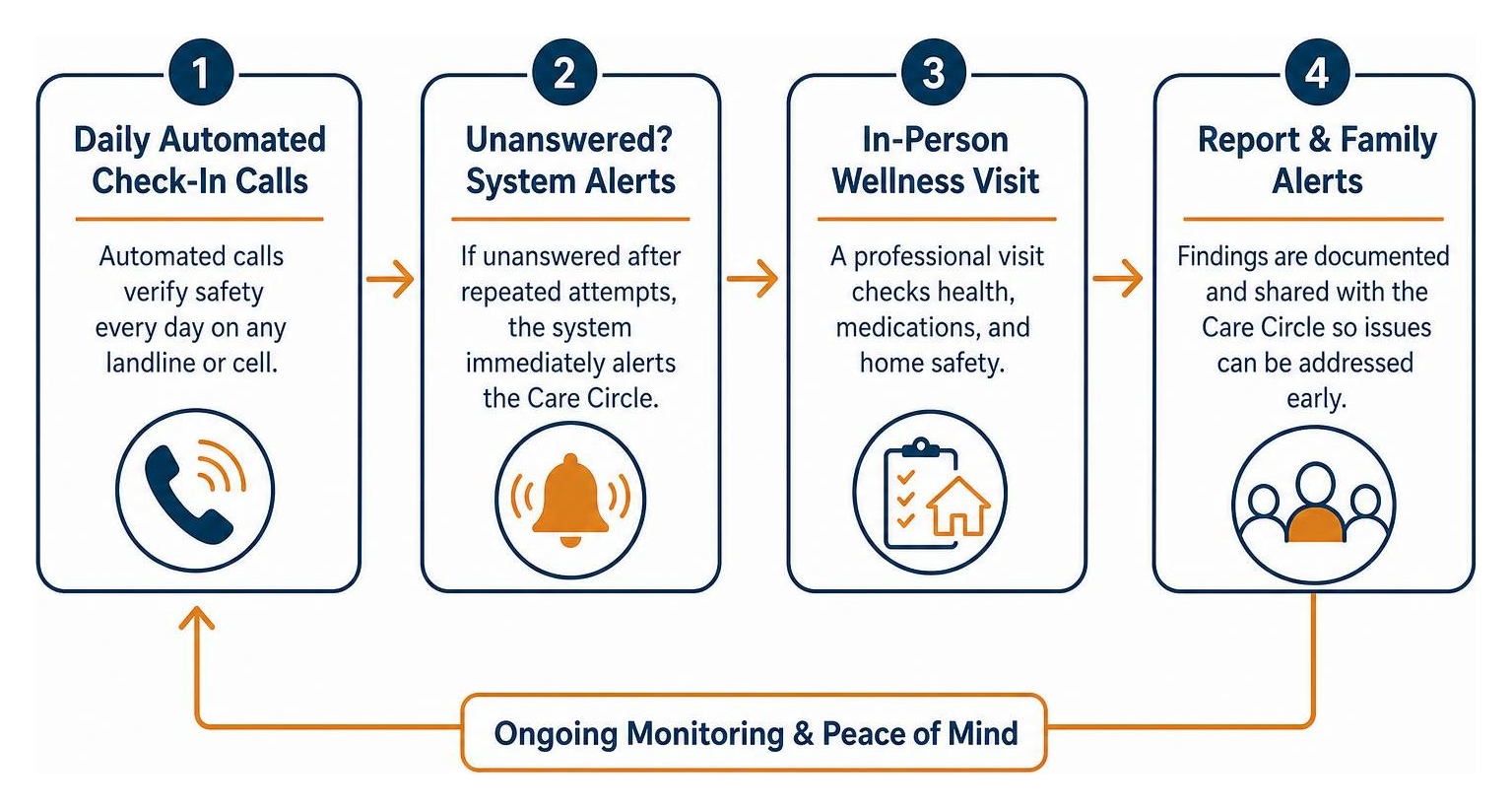
The most effective, reliable approach to senior safety is a hybrid model. Combining periodic in-person wellness visits with automated daily phone check-ins creates an affordable, layered safety net that preserves independence while ensuring daily peace of mind.

Diagram showing the multi-tier senior care cycle from daily automated calls to in-person visits and family alerts

At Caregiver365, we provide automated daily check-in calls designed to verify safety every single day without requiring wearable pendants or complex new hardware. Because our system works seamlessly on any existing landline or cell phone, your loved one simply answers a friendly, automated call at a pre-set time.

If a call goes unanswered after repeated attempts, our system immediately alerts your designated Care Circle—notifying up to eight family members, neighbors, or caregivers via phone call, text, or email.

To learn more about how this safety net operates seamlessly in your daily routine, see how daily check-in calls work and explore the core mechanics of how it works. For additional planning tools and caregiver guides, browse our curated senior support resources.

Frequently Asked Questions About Senior Welfare Checks

How much do non-medical senior wellness visits cost?

Non-medical in-person wellness visits typically range from $30 to $75 per hour, depending on your geographic region and the level of assistance provided. Visits can be scheduled weekly, bi-weekly, or monthly. Families often use automated daily phone check-ins for day-to-day safety to keep overall costs manageable, reserving in-person visits for comprehensive periodic evaluations.

How quickly can an in-person wellness check be arranged?

Routine non-medical visits through local home care agencies or companion services generally require several days of advance notice for an initial intake. If there is an urgent concern about an individual’s immediate safety and family cannot reach them, local non-emergency dispatch or municipal services can perform an urgent welfare check within hours.

What happens if a safety hazard or medical concern is found?

When a visitor identifies an immediate medical emergency, standard protocols dictate calling 911 immediately. For non-emergency concerns—such as expired medication, tripping hazards, or minor home repairs—the visitor logs the findings in a post-visit summary report and directly contacts the primary family caregiver to coordinate necessary modifications.

Conclusion

Supporting an aging loved one’s desire to live independently requires a thoughtful combination of safety, companionship, and proactive communication. In-person visits provide an essential set of caring eyes to spot environmental risks, monitor cognitive wellness, and prevent accidents before they happen.

By pairing periodic home visits with automated daily check-ins, families gain total confidence that their loved ones are safe every single day. Explore our comprehensive senior check-in services today to establish an effortless, dependable safety routine for the people who matter most.

How Caregiver Apps Keep Families in the Loop

How Caregiver Apps Keep Families in the Loop

Quick answer: Caregiver apps keep families connected by centralizing updates, medications, and schedules in one place. Instead of repeating the same news to five different relatives, a caregiver for the elderly can post once and reach everyone instantly. Paired with daily check-in calls, these tools reduce stress, prevent missed medications, and give families real-time peace of mind.

Caring for an aging parent or relative often means juggling phone calls, texts, and group chats just to keep everyone informed. One sibling wants a health update, another needs to know about an upcoming doctor’s appointment, and somewhere in the shuffle, an important detail gets lost. This fragmented communication adds unnecessary stress to an already demanding role.

Caregiver apps solve this problem by creating a single hub where every family member can see the same information at the same time. Combined with daily check-in services, these tools give families a reliable way to stay connected and catch problems early, without constant phone calls or guesswork.

What Are Caregiver Apps and Why Do They Matter?

Caregiver apps are digital platforms built to organize and simplify communication among the people involved in caring for a loved one. They typically include shared updates, medication tracking, and calendars, all in one place.

As more families take on the role of caregiver for the elderly, these apps have become increasingly important. Caregiver apps are designed to streamline communication and coordination among family members involved in caregiving, reducing the burden of repeating the same updates to multiple people.

Rather than sending five separate texts about a doctor’s visit, a primary caregiver can post one update that reaches the entire family circle. This saves time and reduces the mental load that so often falls on a single person.

What Features Keep Families Connected Through Caregiver Apps?

Most caregiver apps share a core set of tools designed to reduce miscommunication and confusion.

1. Single Update Posting

Apps like those recommended by Caregiver365 let caregivers post one update that reaches the whole family. No more retelling the same story five times over the phone.

2. Shared Timelines

A shared timeline gives family, friends, and care professionals visibility into what is happening, when it happened, and who responded. Everyone stays on the same page without needing a separate group chat.

3. Medication Management Tools

Apps such as Medisafe track medication schedules and send alerts for missed doses. This helps ensure a caregiver for the elderly, and everyone else involved, knows immediately if a dose was skipped.

4. Shared Calendars

Shared calendars keep appointments, errands, and caregiving tasks organized in one visible place, so nothing slips through the cracks.

5. Role-Based Permissions

Families can assign specific roles and responsibilities to different members and professionals. This clarifies who handles what, reducing overlap and confusion.

How Do Daily Check-In Services Complement Caregiver Apps?

While caregiver apps handle communication and coordination, daily check-in calls add another layer of protection between updates. Here is how the process typically works:

  1. Choose a time. Families select a time of day for the check-in call and add up to eight people to the Care Circle.
  2. Answer and confirm. The call comes through, and the loved one presses 1 to confirm they are okay.
  3. Missed calls trigger a retry. If the call goes unanswered, the service calls back several times over the following hour.
  4. Family gets alerted. If there is still no response, the Care Circle is notified by phone, text, or email.

This system fills the gaps between app updates, offering reassurance on the days when nothing is posted and everything seems quiet.

What Are the Real-World Benefits of Using Caregiver Apps?

Families who use caregiver apps alongside check-in services often notice meaningful improvements in daily life:

  • Less anxiety. Knowing a loved one is being monitored reduces the constant worry that comes with distance caregiving.
  • Better medication adherence. Alerts and tracking help ensure doses are not missed.
  • Fewer missed appointments. Shared calendars keep everyone aligned on what is coming up.
  • Improved coordination. Clear roles and shared timelines prevent tasks from falling through the cracks.
  • A lasting record. Update histories create a reference point for future care decisions.

Frequently Asked Questions

What is a caregiver app used for?

A caregiver app centralizes communication, medication tracking, and scheduling for families managing care for a loved one, reducing the need for repetitive updates.

Who benefits most from caregiver apps?

Families acting as caregivers for the elderly, especially those coordinating care across multiple relatives or long distances, benefit most from the centralized communication these apps provide.

Do caregiver apps replace daily check-in calls?

No. Caregiver apps handle communication and coordination, while daily check-in calls add a real-time safety layer between updates, alerting families quickly if something seems wrong.

What happens if a loved one misses a check-in call?

The service retries the call several times over the next hour. If there is still no answer, the Care Circle is notified by phone, text, or email.

Take the Next Step Toward Peace of Mind

Caregiving becomes easier when families have the right tools in place. If you have a loved one who is losing independence due to age or health, consider pairing a caregiver app with a daily check-in service recommended by Caregiver365. Together, these tools offer a simple, reliable way to stay connected and catch problems before they become emergencies.

When to Request Professional Wellness Checks for Seniors Living Alone

When to Request Wellness Checks for Seniors Living Alone

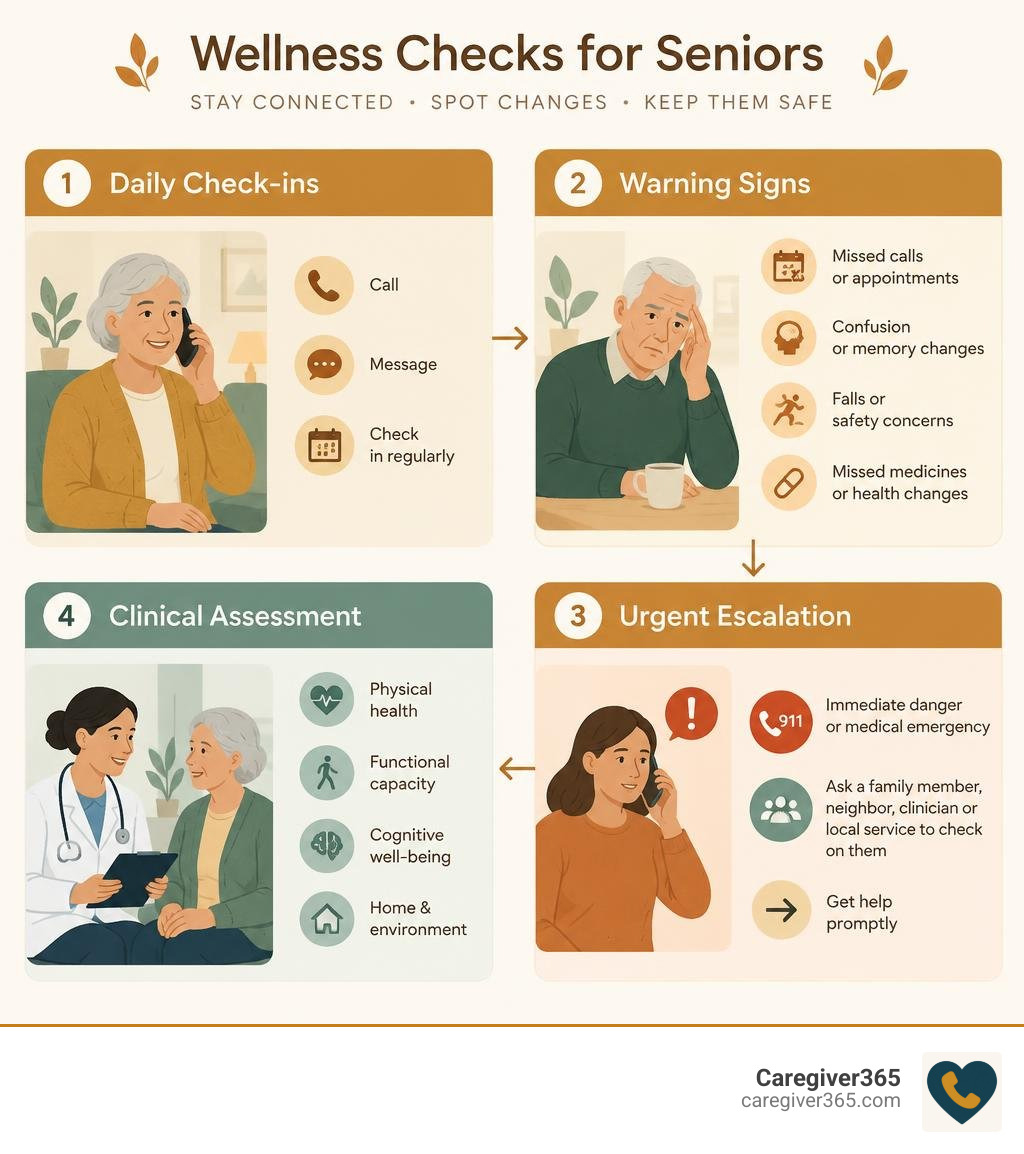
Wellness checks for seniors are worth requesting when an older parent who lives alone has a sudden change in routine, health, safety, or communication. Start with simple daily contact. If they miss calls, seem confused, fall, skip medicines or appointments, or cannot be reached, ask a nearby family member, neighbor, clinician, or local non-emergency service to check on them promptly. For an immediate danger or medical emergency, call 911.

A wellness check is not just a question of whether someone answers the phone. It can be an early warning system for changes that make living alone less safe, from falls and medication problems to loneliness and memory concerns.

For families, the goal is simple: create a dependable safety net that respects independence while making sure someone notices when something is wrong.

Infographic showing daily check-ins, warning signs, urgent escalation, and clinical assessment infographic

Understanding Clinical Wellness Checks for Seniors and Geriatric Assessments

As our loved ones age, their medical needs evolve from simple, single-issue primary care visits into complex webs of physical health, functional capacity, and cognitive well-being. Today, adults over the age of 65 account for well over a third of all primary care visits—a number that continues to climb as our population ages. Navigating this stage of life requires more than just reacting to acute illnesses; it demands a structured, proactive approach to longevity and health span.

At the core of proactive geriatric care is the clinical evaluation. According to established Comprehensive Geriatric Assessment guidelines, evaluating an older individual must extend far beyond standard vital signs. A true wellness check combines medical diagnostic rigor with a deep understanding of how a senior lives, moves, and navigates their environment every single day.

Comprehensive Geriatric Assessment vs. Standard Physicals

A standard adult physical focuses on reviewing organ systems, managing isolated symptoms, and adjusting prescriptions. In contrast, a Comprehensive Geriatric Assessment (CGA) is an intensive, multidimensional process designed to uncover hidden vulnerabilities before they turn into emergencies.

Rather than relying on a single physician looking at blood pressure cuffs and lab results, an effective CGA often draws upon an interdisciplinary team—such as family physicians, nurses, physical therapists, pharmacists, and social workers. This team evaluates:

  • Physical Health: Evaluating chronic conditions, sensory loss, nutrition, and systemic health.
  • Functional Status: Measuring the ability to perform daily tasks independently.
  • Cognitive & Psychological Well-being: Screening for memory impairment, executive dysfunction, and mood disorders.
  • Socioenvironmental Safety: Reviewing the safety of the living space, caregiver support networks, and financial security.

Evidence shows that this holistic evaluation delivers dramatic results. Regular geriatric assessments lead to reduced mortality, lower rates of acute hospital admissions, and a measurable decrease in nursing home placements, all while increasing overall satisfaction with care.

The 4Ms Age-Friendly Framework in Practice

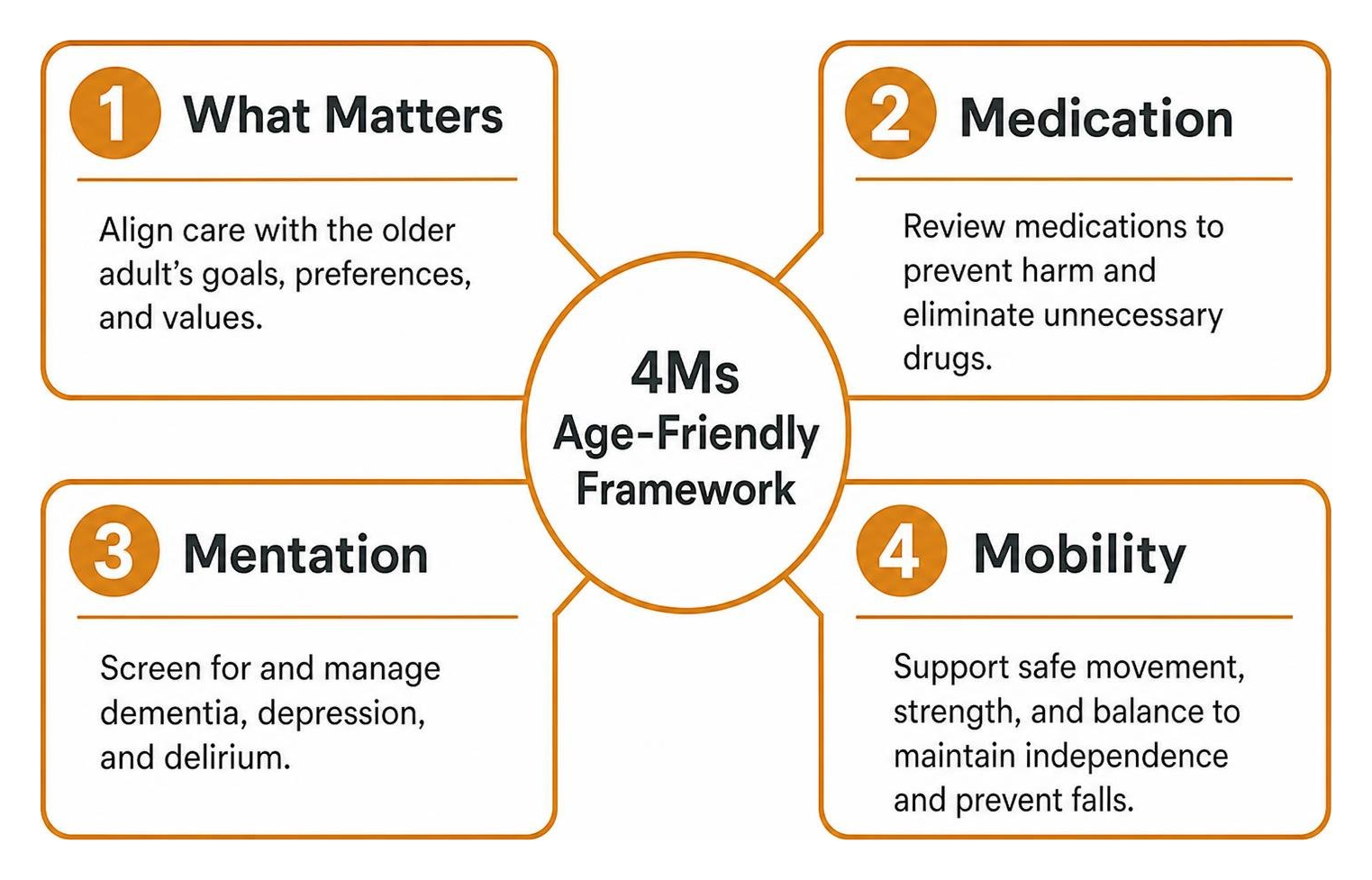
To streamline this comprehensive evaluation without overwhelming busy medical clinics, geriatric medicine relies on the Age-Friendly Health Systems model. Applying Age-Friendly Geriatric Assessment principles centers clinical visits around four core pillars known as the 4Ms:

  1. What Matters: Aligning the entire care plan with the older adult’s personal goals, preferences, and values. This includes advance care planning, understanding end-of-life wishes, and tailoring treatments to maintain the specific lifestyle priorities of the individual.
  2. Medication: Reviewing all prescriptions, over-the-counter supplements, and herbal products to prevent adverse drug events and eliminate unnecessary medications.
  3. Mentation: Actively screening for and managing dementia, depression, and delirium across all care settings.
  4. Mobility: Ensuring older adults retain the strength and balance needed to move safely, maintain independence, and prevent debilitating falls.

Some clinicians also incorporate a fifth M—Multicomplexity—to address the compounding challenges that arise when multiple chronic illnesses overlap with social vulnerability.

Diagram of the 4Ms Age-Friendly Framework: What Matters, Medication, Mentation, and Mobility

Essential Screening Tools and Functional Independence Metrics

physician conducting cognitive and balance screenings with a senior

During an in-person clinical wellness check, objective screening tools replace guesswork with measurable health data. These quick, standardized instruments help clinicians and families identify subtle declines long before they cause a crisis.

Cognitive, Mood, and Mobility Screenings

Clinical assessments rely on brief, validated tools that can be administered in standard office visits:

  • Mini-Cog: A quick screening test combining a three-item word recall with a clock-drawing test. It rapidly flags cognitive impairment and executive dysfunction, saving valuable time during routine exams.
  • Geriatric Depression Scale (GDS-15): A short, 15-question instrument designed specifically to screen for depressive symptoms in older adults, differentiating clinical depression from cognitive decline or normal aging.
  • STEADI Fall Risk Protocol: Developed by the CDC, the Stopping Elderly Accidents, Deaths, & Injuries (STEADI) framework begins with three simple questions: Have you fallen in the past year? Do you feel unsteady when standing or walking? Do you worry about falling? A positive answer triggers physical mobility tests like the Timed Up and Go (TUG) test, a 30-second chair stand, and a four-stage balance assessment, leading to targeted physical therapy referrals when needed.

Evaluating ADLs, IADLs, and Socioenvironmental Factors

Maintaining independence at home requires mastery of two distinct levels of daily function:

  • Activities of Daily Living (ADLs): Basic self-care tasks essential for survival, including bathing, dressing, toileting, transferring (moving from bed to chair), eating, and maintaining continence.
  • Instrumental Activities of Daily Living (IADLs): Complex activities required for independent community living, including managing finances, handling medications, preparing meals, shopping for groceries, using the telephone, and managing housekeeping.

When a senior begins struggling with IADLs, it is often the first visible indicator that their home environment needs additional support. In addition to functional metrics, clinicians and families must evaluate socioenvironmental health: checking for home hazards like loose rugs or poor lighting, assessing caregiver burnout, evaluating food security, and consulting community-based senior safety and caregiver resources to reinforce the safety net around the home.

Identifying When to Request Immediate Interventions

concerned adult child reviewing daily routines with an aging parent

While scheduled clinical visits are necessary, real-world decline often happens between doctor appointments. Family members, neighbors, and long-distance caregivers must know how to spot emerging crises early.

Warning Signs That Signal When to Request Urgent Wellness Checks for Seniors

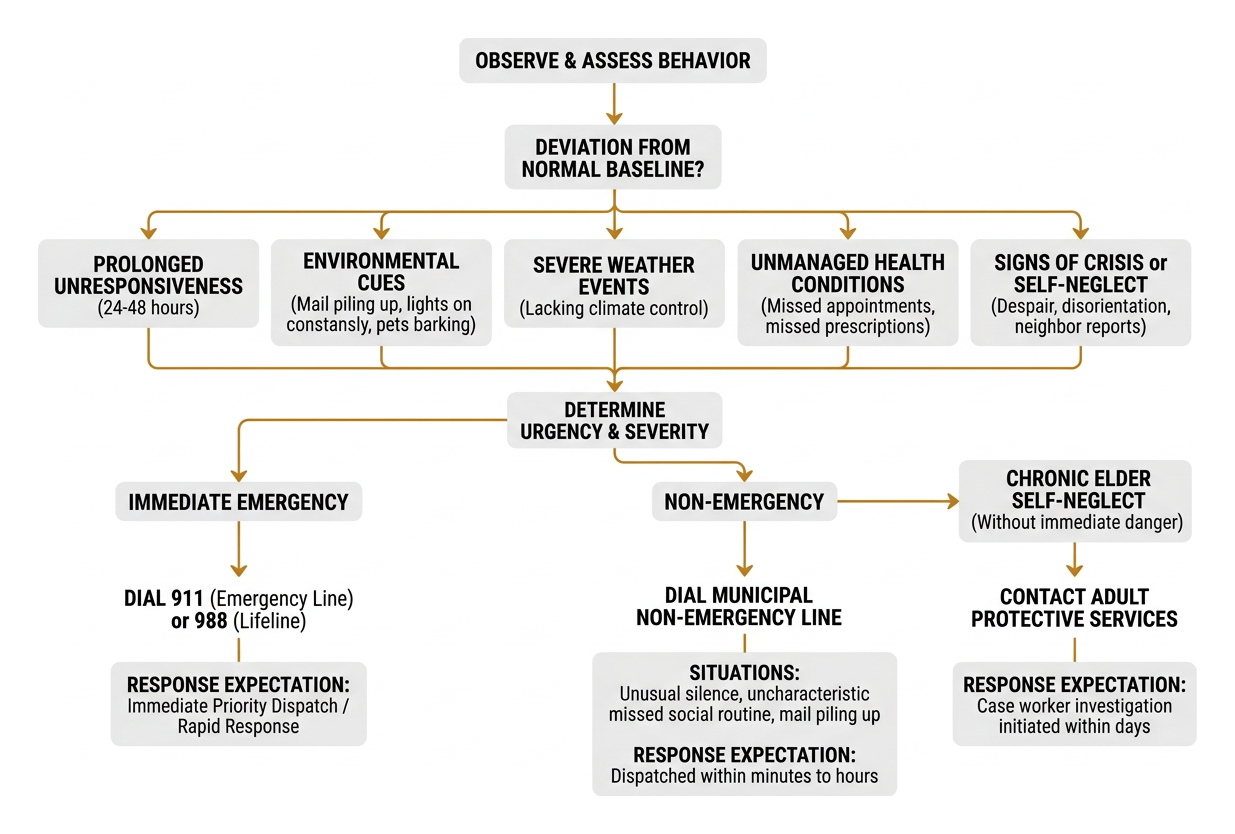
If an older adult living alone exhibits sudden changes in behavior or environment, do not wait for the next annual appointment. Request an urgent check if you notice:

  • Communication Breakdowns: Multiple unanswered phone calls, unreturned messages, or a sudden inability to reach them during their normal daily routine.
  • Physical Neglect: Rapid, unexplained weight loss, unwashed clothing, poor personal hygiene, or obvious unsteadiness and unexplained bruising.
  • Household Disarray: Spoiled food sitting on counters, stacks of unopened bills, unpaid utility notices, medication bottles left scattered or untouched, or dangerous clutter near walkways.
  • Disorientation: Missed medical appointments, confusion about the day or time, or conversations that seem unusually unorganized.

When immediate contact fails and you suspect acute danger, you can coordinate with local law enforcement or social services. Understanding the steps for requesting an urgent welfare check by phone or online ensures you know how dispatch protocols work, what information to provide, and how emergency responders handle non-emergency welfare checks on vulnerable adults.

Polypharmacy Risks and Metabolic Changes

One of the most frequent causes of sudden functional decline is medication mismanagement. Polypharmacy—defined as the routine use of five or more medications—significantly increases the risk of adverse drug interactions, dizziness, cognitive fog, and falls.

Clinicians use evidence-based criteria like the American Geriatrics Society Beers Criteria® and STOPP/START (Screening Tool of Older Persons’ Prescriptions / Screening Tool to Alert to Right Treatment) guidelines to identify potentially inappropriate medications for older adults. For example, sedatives, strong anticholinergics, and certain blood pressure medications can trigger sudden drops in blood pressure upon standing (orthostatic hypotension), leading to balance loss.

Regular medication reconciliations ensure that dosage adjustments, newly prescribed therapies, and metabolic changes are managed without creating dangerous side effects.

Medicare Coverage and Daily Safety Support Systems

Navigating healthcare resources and daily safety layers is essential for keeping seniors safe while respecting their autonomy.

Medicare Part B covers an Annual Wellness Visit (AWV) at no cost to the beneficiary. It is important to remember that the AWV is not an invasive, head-to-toe physical examination. Instead, it is a dedicated conversation focused on creating or updating a personalized prevention plan.
During an AWV, clinicians review:

  • Medical, surgical, and family history.
  • Current providers, prescriptions, and suppliers.
  • Routine measurements (height, weight, blood pressure, BMI).
  • Cognitive impairment and depression screenings.
  • Fall risk and functional ability assessments.
  • Preventive screening schedules and immunization updates.

Medicare also offers structured support through programs like the Medicare Diabetes Prevention Program for lifestyle management, alongside evolving coverage criteria for chronic metabolic conditions.

Feature Clinical Medicare Annual Wellness Visit Daily Remote Check-In System
Frequency Once every 12 months Daily (customizable time)
Primary Focus Long-term prevention, screening, care plans Immediate safety confirmation, routine tracking
Provider Physician, Nurse Practitioner, or Clinical Team Automated communication service & Care Circle
Key Action Updates medical records & orders screenings Confirms well-being; alerts family if call is missed
Cost Model Covered 100% by Medicare Part B Low-cost monthly subscription

Integrating Daily Wellness Checks for Seniors with Emergency Response

A clinical checkup once a year is critical for long-term health, but it cannot verify if an aging parent got out of bed safely this morning. That is why families build a multi-layered safety net combining clinical care, daily check-ins, and emergency tools.

While wearable panic buttons are common, many seniors choose not to wear them, leave them on the nightstand, or forget to charge them. Additionally, if an individual suffers a severe fall or sudden medical event causing loss of consciousness, they cannot press a button.

We believe the most reliable way to monitor daily safety is through scheduled, passive contact. Learning how daily automated check-in systems work illustrates how automated phone calls can bridge the gap between doctor visits. By requiring no wearable hardware, these systems operate reliably over any standard landline or cell phone, systematically alerting a designated family Care Circle if a scheduled call goes unanswered.

Diagram showing daily safety loop: Daily call to senior answers to status OK; or if missed to Care Circle alerted to prompt

Frequently Asked Questions About Senior Wellness Checks

What is the difference between a Medicare Annual Wellness Visit and a regular physical exam?

A Medicare Annual Wellness Visit (AWV) is a preventive planning consultation, not a traditional physical exam. The provider will not listen to your heart and lungs, perform reflexive taps, or draw routine diagnostic bloodwork unless a specific concern arises. Instead, the AWV focuses on updating medical history, screening for cognitive decline, assessing depression and fall risk, reviewing medications, and drafting a 5-to-10-year personalized prevention plan. It is covered fully by Medicare Part B with zero copay.

How does routine wellness monitoring help prevent hospital readmissions?

Regular daily monitoring creates early detection channels. When an older adult misses a daily check-in call or mentions mild dizziness to a family member during a follow-up, caregivers can intervene before a minor issue escalates into a catastrophic fall, dehydration, or an adverse medication event. Consistent communication ensures medication adherence, catches changes in mobility early, and prevents the complications that commonly send seniors to the emergency room.

What steps are involved in a clinical fall risk assessment?

A clinical fall risk assessment follows the CDC STEADI guidelines:

  1. Initial Screening: Asking if the patient has fallen in the past year, feels unsteady, or worries about falling.
  2. Gait and Balance Testing: Conducting physical performance tests like the Timed Up and Go (TUG) test, 30-Second Chair Stand, and 4-Stage Balance Test.
  3. Vital Signs & Sensory Checks: Assessing orthostatic vital signs (checking blood pressure while lying down versus standing) and evaluating visual acuity.
  4. Medication Review: Identifying and tapering drugs that cause sedation or dizziness.
  5. Intervention Plan: Prescribing physical therapy, recommending vitamin D supplementation if deficient, and ordering home hazard assessments.

Conclusion

Helping an aging parent remain safe and independent at home does not require taking away their freedom. By pairing comprehensive clinical evaluations—guided by the 4Ms and validated screening tools—with consistent, day-to-day oversight, families can build a comprehensive support system that catches health declines early and responds to emergencies instantly.

At Caregiver365, our mission is to deliver dependable peace of mind to families everywhere. Our automated check-in service places a daily call to your loved one’s existing home phone or mobile device at the exact time you choose. When they answer, their well-being is confirmed. If they miss the call, our system immediately alerts up to eight members of your family Care Circle so someone can step in right away. Discover how daily check-in calls work to protect seniors living alone and keep your loved ones safe, connected, and thriving in the comfort of home.

Practical Guide to Requesting a Senior Welfare Check Online or by Phone

Request a Senior Welfare Check Quickly and Safely

If you are worried about an older parent who lives alone and cannot be reached, take these steps:

  1. Call 911 now if you believe there is immediate danger, such as a fall, medical emergency, suicidal statements, overdose risk, or signs of a break-in.
  2. Call the local police non-emergency number if the concern is serious but not clearly life-threatening. Contact the agency where your parent lives, not where you live.
  3. Share specific facts: their full name, exact address, last known contact, health conditions, medications, mobility needs, pets, and any door or gate access details.
  4. Stay available for follow-up. Officers may confirm only limited information because of privacy rules.

A welfare check is an in-person safety visit, usually by local law enforcement, to see whether someone is okay. It is generally free to request, though ambulance transport or medical treatment can create separate bills.

For a mental-health crisis where there is not an immediate physical threat, calling or texting 988 may connect you with crisis support and, where available, a mobile crisis team rather than police.

When to call 911, non-emergency police, or 988 for a senior welfare check infographic

Understanding Wellness Checks: When Is a Visit Necessary?

police officer conducting a routine wellness visit

A welfare check (also known as a wellness check or safety visit) occurs when first responders—typically local police officers, sheriff’s deputies, or community crisis workers—visit an individual’s residence to assess their physical safety and well-being. Anyone with legitimate concerns can ask for one, whether you are an adult child living three states away, a worried neighbor, or a close friend.

Understanding the legal parameters of wellness checks helps demystify the process. Officers are not arriving to search the house for wrongdoing or make arrests; their primary objective is non-criminal. They knock, announce themselves, observe environmental indicators, and verify that the resident is safe, conscious, and uninjured.

Warning Signs That Warrant an Urgent Safety Check

It is entirely normal to feel uneasy when an aging loved one suddenly falls out of touch. However, before requesting law enforcement resources, we recommend assessing whether their behavior deviates significantly from their normal baseline.

Common situations that justify a formal check include:

  • Prolonged unresponsiveness: An elderly relative who answers the phone every morning misses multiple scheduled calls across 24 to 48 hours without explanation.
  • Environmental cues: Piled-up mail overflowing the mailbox, deliveries left on the porch, interior lights left burning constantly for days, or pets barking persistently inside.
  • Severe weather events: Heat waves, freezing temperatures, or localized power outages where an older adult with mobility or cognitive limitations lacks functioning climate control.
  • Unmanaged health conditions: A senior with brittle diabetes, severe heart disease, or early dementia misses vital medical appointments or fails to pick up critical prescriptions.
  • Signs of crisis or self-neglect: Direct statements suggesting severe despair, disorientation during your last conversation, or reports from neighbors regarding unsafe living conditions.

Deciding Between 911 Emergency and Non-Emergency Lines

One of the most important decisions is choosing which number to dial. Calling 911 routes your call to an emergency dispatcher who prioritizes immediate, life-or-death scenarios. Dialing the municipal non-emergency line places your request into a standard queue, preventing vital emergency lines from being tied up while ensuring patrol officers still conduct the check during their shift.

Situation / Scenario Recommended Channel Response Expectation
Suspected fall, stroke, or active medical emergency 911 Emergency Immediate priority dispatch with lights/sirens
Explicit statements of self-harm or active suicidal crisis 911 or 988 Lifeline Rapid response; mobile crisis or law enforcement
24–48 hours of unusual silence with chronic health issues Non-Emergency Line Dispatched within minutes to a few hours based on volume
Mail piling up, uncharacteristic missed social routine Non-Emergency Line Routine patrol check scheduled during active shift
Chronic elder self-neglect without immediate physical danger Adult Protective Services Case worker investigation initiated within days

Step-by-Step: How to Do a Welfare Check on Someone

When learning how to do a welfare check on someone, following a structured process helps dispatchers route help quickly and gives responding personnel the exact context they need.

Decision process for initiating a safety check

Preparing Critical Details: How to Do a Welfare Check on Someone with Health Risks

Before placing the call, spend two minutes gathering essential details. Having concise notes prevents frantic back-and-forth and gives responders an immediate profile of the residence. Follow this practical checklist when requesting local authority welfare checks:

  1. Full Identification: Legal name, preferred name, age, and date of birth.
  2. Exact Location: Complete street address, apartment or unit number, building entry codes, and cross streets.
  3. Physical Description & Mobility: Height, weight, hair color, and whether they use a cane, walker, or wheelchair.
  4. Medical Background: Major diagnoses (e.g., dementia, diabetes, Parkinson’s, pacemaker) and life-sustaining medications.
  5. Sensory Impairments: Severe hearing loss (explaining why they might not hear the doorbell) or visual impairments.
  6. Property Layout & Hazards: Presence of pets (such as a protective dog), spare keys hidden outside, or weapons in the home.
  7. Vehicles: Make, model, and license plate of any car normally parked in the driveway.
  8. Your Relationship & Contact Info: How you are connected, your phone number, and a request for an officer callback once the visit is complete.

Contacting Dispatch: How to Do a Welfare Check on Someone in Another City

If your loved one lives in a different city, county, or state, do not simply dial 911 from your local phone, as that connects you to your local county dispatch center.

Instead, look up the municipality or county sheriff’s department where your loved one resides and dial their 10-digit non-emergency dispatch number. If you are experiencing a true long-distance emergency (such as hearing your parent collapse while on the phone), search for that specific jurisdiction’s primary emergency dispatch number or request an immediate transfer from your local 911 operator.

When speaking with the dispatcher:

  • Speak calmly and state clearly: “I am requesting a welfare check on my elderly mother who lives alone at [Address]. I have not been able to reach her for [Timeframe], which is completely out of character given her daily routine.”
  • Provide the medical and property details you prepared.
  • Explicitly ask: “Could you please have the responding officer call me with an update once they have checked the home?”

Many families wonder what officers are legally permitted to do when they arrive at the property. Police officers cannot simply kick down doors at will during wellness visits.

Warrantless Entry Limits and Subject Privacy

Under the Fourth Amendment of the U.S. Constitution, individuals enjoy strict protections against warrantless government intrusions into their homes. In 2021, the Supreme Court unanimously held in Caniglia v. Strom that the so-called “community caretaking” exception does not give law enforcement officers a blank license to enter private residences without a warrant simply because they are performing a wellness check. Furthermore, in January 2026, the Supreme Court reiterated that vague “community caretaker” arguments cannot justify entering someone’s home without a warrant, calling such reasoning ill-advised.

Instead, forced entry during a welfare check is strictly governed by the Emergency Aid Doctrine. To enter without permission or a warrant, officers must have an objectively reasonable belief that someone inside is actively experiencing serious physical injury or faces imminent danger.

What this looks like in practice:

  • Doorstep Assessment: Officers knock, ring the bell, and call out loudly. They inspect perimeter windows, look for fallen objects, listen for faint cries for help, and check if the vehicle is parked outside.
  • If the Senior Refuses Entry: A competent adult has the legal right to decline opening the door or inviting officers inside. If the senior speaks through the door, appears lucid, and confirms they are safe and do not want assistance, officers must respect their privacy and depart.
  • When Entry Occurs: If officers look through a window and spot an individual unresponsive on the floor, smell gas or smoke, or hear groaning, the emergency aid threshold is met, allowing immediate entry (often assisted by the local fire department) to render medical aid.

Post-Check Protocols and Potential Emergency Care Costs

emergency medical responders assisting senior

Once responders conclude their visit, the outcome generally falls into one of four categories:

  1. Safe and Sound: The resident was napping in the backyard, had a dead phone battery, or simply misplaced their handset. The officer reports back that all is well.
  2. Medical Assistance & Transport: If a fall, stroke, or severe illness is discovered, paramedics provide immediate triage. If hospital transport is required, be aware that ground ambulance bills commonly run between $900 and $1,300 before insurance. Ground ambulance services are not covered by the federal No Surprises Act’s balance-billing protections.
  3. Mental Health Assessment: If an individual presents an imminent danger to themselves or others due to severe psychiatric decompensation, officers or crisis workers may initiate an involuntary psychiatric evaluation hold. Every state has a legal process for this, though terminology varies (such as a “5150” in California or a “Baker Act” in Florida).
  4. Mandatory Reporting: If officers uncover active neglect, extreme elder abuse, or squalor, they are required by law to file a referral with Adult Protective Services (APS).

Crisis Alternatives and Proactive Senior Monitoring

While police welfare checks serve as an indispensable emergency safety net, they are not always the ideal first choice for non-violent behavioral health episodes or routine eldercare reassurance. Involving armed law enforcement can occasionally cause distress, confusion, or agitation in seniors living with Alzheimer’s or dementia.

Fortunately, modern care ecosystems provide dedicated alternatives to traditional police responses, as well as proactive senior check-in solutions that catch issues before they escalate into 911 emergencies.

Utilizing the 988 Lifeline and Mental Health Responders

If your concern stems primarily from an acute emotional or mental health crisis rather than a physical medical emergency, the national 988 Suicide & Crisis Lifeline offers a vital resource.

The 988 Lifeline is designed to resolve crises in the least restrictive way possible. When you call or text 988 on behalf of a loved one, trained counselors assess the situation. In hundreds of communities across the country, 988 dispatchers can deploy Mobile Crisis Teams (MCTs) or co-responder units—staffed by mental health clinicians and specialized paramedics rather than armed patrol officers—ensuring compassionate, trauma-informed de-escalation.

For ongoing, non-acute concerns regarding a vulnerable adult’s living conditions, hygiene, or potential exploitation, contacting your local Adult Protective Services (APS) agency is often the most constructive route. APS case managers conduct comprehensive home visits aimed at connecting seniors with social services, food assistance, and home care.

Preventing Crisis Visits with Proactive Daily Check-Ins

The vast majority of welfare checks are triggered by simple breakdowns in communication: a forgotten phone charger, an afternoon nap with the ringer silenced, or a family member out of town. The panic is real, but sending police out for a false alarm takes an emotional toll on everyone involved.

Framework comparing reactive welfare checks to proactive daily check-ins

Establishing an automated daily routine helps prevent these frightening communication gaps. Rather than waiting for a missed Sunday call to spark panic, exploring how automated check-in systems work allows families to build a structured safety net.

At Caregiver365, we provide an automated daily phone-call check-in service designed specifically for independent seniors.

  • Universal Compatibility: The service calls your loved one’s existing landline or cell phone at a pre-scheduled time every day—no apps, wearable pendants, or new hardware required.
  • Care Circle Alerts: When your parent answers and presses a button to confirm they are doing well, their day continues uninterrupted. If they fail to answer after multiple automated attempts, our system immediately alerts their designated “Care Circle” of up to eight family members and caregivers via text and phone.
  • Early Detection: This proactive approach gives families hours of early warning to reach out to a neighbor or visit the home personally, resolving issues long before an emergency welfare check becomes necessary.

Frequently Asked Questions About Senior Welfare Checks

Can I request a welfare check anonymously?

Yes, most municipal police departments and sheriff’s offices allow callers to remain anonymous. However, identifying yourself and providing a callback number is strongly recommended. Providing your contact details enhances the credibility and priority of the request, enables dispatchers to call you back for additional gate codes or pet details, and allows the responding officer to update you on your loved one’s status.

Does requesting a senior welfare check cost money?

No. Welfare checks conducted by local law enforcement or municipal public safety agencies are a free public service funded by taxpayer dollars. You will not receive a bill simply because an officer drove to the home and knocked on the door. Financial charges only arise if external medical intervention is required, such as paramedic treatment, emergency room admission, or private ground ambulance transportation.

What happens if an elderly person refuses to open the door?

If the resident is conscious and speaks through the door stating they are fine and refusing entry, officers cannot legally force their way in unless they observe specific evidence of imminent danger or severe medical distress (such as visible blood, smoke, or disorientation indicating an altered mental state). If the senior appears lucid and independent, officers will document that verbal contact was made, ensure no visible distress was observed, and notify the requester that the resident chose not to open the door.

Conclusion

Requesting a welfare check is an act of deep care and responsibility. When an aging parent or vulnerable relative stops answering the phone, knowing whether to dial 911, contact non-emergency dispatch, or reach out to specialized crisis resources gives you the clarity needed to act decisively. Always provide clear, actionable details to dispatchers, remain by your phone for updates, and respect the legal boundaries that protect your loved one’s privacy.

To protect your family from the stress of emergency safety checks, discover how daily check-in calls work with Caregiver365. By establishing a reliable daily touchpoint that alerts your Care Circle at the first sign of silence, you can ensure your loved ones remain safe, independent, and connected every single day.