
Request a Senior Welfare Check Quickly and Safely
If you are worried about an older parent who lives alone and cannot be reached, take these steps:
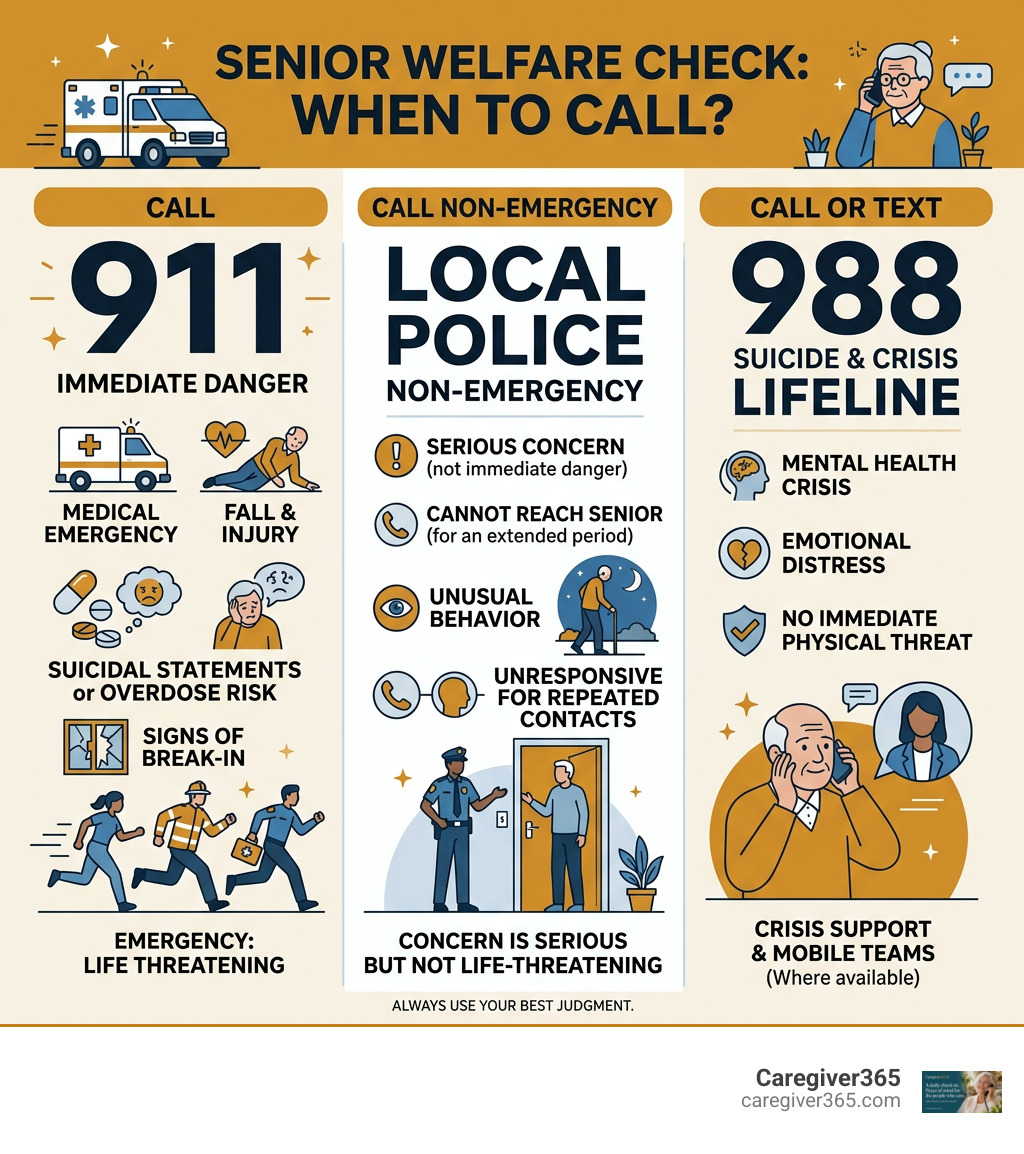
- Call 911 now if you believe there is immediate danger, such as a fall, medical emergency, suicidal statements, overdose risk, or signs of a break-in.
- Call the local police non-emergency number if the concern is serious but not clearly life-threatening. Contact the agency where your parent lives, not where you live.
- Share specific facts: their full name, exact address, last known contact, health conditions, medications, mobility needs, pets, and any door or gate access details.
- Stay available for follow-up. Officers may confirm only limited information because of privacy rules.
A welfare check is an in-person safety visit, usually by local law enforcement, to see whether someone is okay. It is generally free to request, though ambulance transport or medical treatment can create separate bills.
For a mental-health crisis where there is not an immediate physical threat, calling or texting 988 may connect you with crisis support and, where available, a mobile crisis team rather than police.
Understanding Wellness Checks: When Is a Visit Necessary?

A welfare check (also known as a wellness check or safety visit) occurs when first responders—typically local police officers, sheriff’s deputies, or community crisis workers—visit an individual’s residence to assess their physical safety and well-being. Anyone with legitimate concerns can ask for one, whether you are an adult child living three states away, a worried neighbor, or a close friend.
Understanding the legal parameters of wellness checks helps demystify the process. Officers are not arriving to search the house for wrongdoing or make arrests; their primary objective is non-criminal. They knock, announce themselves, observe environmental indicators, and verify that the resident is safe, conscious, and uninjured.
Warning Signs That Warrant an Urgent Safety Check
It is entirely normal to feel uneasy when an aging loved one suddenly falls out of touch. However, before requesting law enforcement resources, we recommend assessing whether their behavior deviates significantly from their normal baseline.
Common situations that justify a formal check include:
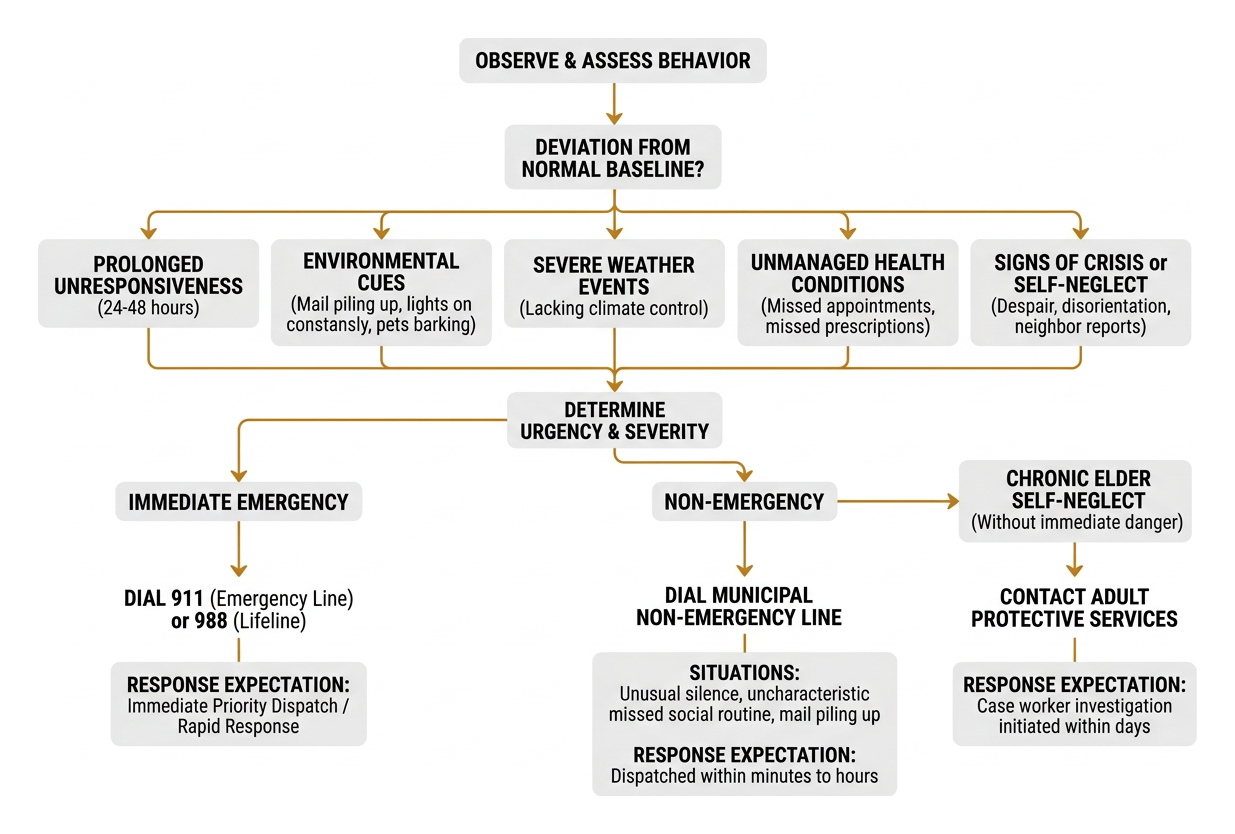
- Prolonged unresponsiveness: An elderly relative who answers the phone every morning misses multiple scheduled calls across 24 to 48 hours without explanation.
- Environmental cues: Piled-up mail overflowing the mailbox, deliveries left on the porch, interior lights left burning constantly for days, or pets barking persistently inside.
- Severe weather events: Heat waves, freezing temperatures, or localized power outages where an older adult with mobility or cognitive limitations lacks functioning climate control.
- Unmanaged health conditions: A senior with brittle diabetes, severe heart disease, or early dementia misses vital medical appointments or fails to pick up critical prescriptions.
- Signs of crisis or self-neglect: Direct statements suggesting severe despair, disorientation during your last conversation, or reports from neighbors regarding unsafe living conditions.
Deciding Between 911 Emergency and Non-Emergency Lines
One of the most important decisions is choosing which number to dial. Calling 911 routes your call to an emergency dispatcher who prioritizes immediate, life-or-death scenarios. Dialing the municipal non-emergency line places your request into a standard queue, preventing vital emergency lines from being tied up while ensuring patrol officers still conduct the check during their shift.
| Situation / Scenario | Recommended Channel | Response Expectation |
|---|---|---|
| Suspected fall, stroke, or active medical emergency | 911 Emergency | Immediate priority dispatch with lights/sirens |
| Explicit statements of self-harm or active suicidal crisis | 911 or 988 Lifeline | Rapid response; mobile crisis or law enforcement |
| 24–48 hours of unusual silence with chronic health issues | Non-Emergency Line | Dispatched within minutes to a few hours based on volume |
| Mail piling up, uncharacteristic missed social routine | Non-Emergency Line | Routine patrol check scheduled during active shift |
| Chronic elder self-neglect without immediate physical danger | Adult Protective Services | Case worker investigation initiated within days |
Step-by-Step: How to Do a Welfare Check on Someone
When learning how to do a welfare check on someone, following a structured process helps dispatchers route help quickly and gives responding personnel the exact context they need.
Preparing Critical Details: How to Do a Welfare Check on Someone with Health Risks
Before placing the call, spend two minutes gathering essential details. Having concise notes prevents frantic back-and-forth and gives responders an immediate profile of the residence. Follow this practical checklist when requesting local authority welfare checks:
- Full Identification: Legal name, preferred name, age, and date of birth.
- Exact Location: Complete street address, apartment or unit number, building entry codes, and cross streets.
- Physical Description & Mobility: Height, weight, hair color, and whether they use a cane, walker, or wheelchair.
- Medical Background: Major diagnoses (e.g., dementia, diabetes, Parkinson’s, pacemaker) and life-sustaining medications.
- Sensory Impairments: Severe hearing loss (explaining why they might not hear the doorbell) or visual impairments.
- Property Layout & Hazards: Presence of pets (such as a protective dog), spare keys hidden outside, or weapons in the home.
- Vehicles: Make, model, and license plate of any car normally parked in the driveway.
- Your Relationship & Contact Info: How you are connected, your phone number, and a request for an officer callback once the visit is complete.
Contacting Dispatch: How to Do a Welfare Check on Someone in Another City
If your loved one lives in a different city, county, or state, do not simply dial 911 from your local phone, as that connects you to your local county dispatch center.
Instead, look up the municipality or county sheriff’s department where your loved one resides and dial their 10-digit non-emergency dispatch number. If you are experiencing a true long-distance emergency (such as hearing your parent collapse while on the phone), search for that specific jurisdiction’s primary emergency dispatch number or request an immediate transfer from your local 911 operator.
When speaking with the dispatcher:
- Speak calmly and state clearly: “I am requesting a welfare check on my elderly mother who lives alone at [Address]. I have not been able to reach her for [Timeframe], which is completely out of character given her daily routine.”
- Provide the medical and property details you prepared.
- Explicitly ask: “Could you please have the responding officer call me with an update once they have checked the home?”
Legal Authorities, Resident Rights, and Visit Outcomes
Many families wonder what officers are legally permitted to do when they arrive at the property. Police officers cannot simply kick down doors at will during wellness visits.
Warrantless Entry Limits and Subject Privacy
Under the Fourth Amendment of the U.S. Constitution, individuals enjoy strict protections against warrantless government intrusions into their homes. In 2021, the Supreme Court unanimously held in Caniglia v. Strom that the so-called “community caretaking” exception does not give law enforcement officers a blank license to enter private residences without a warrant simply because they are performing a wellness check. Furthermore, in January 2026, the Supreme Court reiterated that vague “community caretaker” arguments cannot justify entering someone’s home without a warrant, calling such reasoning ill-advised.
Instead, forced entry during a welfare check is strictly governed by the Emergency Aid Doctrine. To enter without permission or a warrant, officers must have an objectively reasonable belief that someone inside is actively experiencing serious physical injury or faces imminent danger.
What this looks like in practice:
- Doorstep Assessment: Officers knock, ring the bell, and call out loudly. They inspect perimeter windows, look for fallen objects, listen for faint cries for help, and check if the vehicle is parked outside.
- If the Senior Refuses Entry: A competent adult has the legal right to decline opening the door or inviting officers inside. If the senior speaks through the door, appears lucid, and confirms they are safe and do not want assistance, officers must respect their privacy and depart.
- When Entry Occurs: If officers look through a window and spot an individual unresponsive on the floor, smell gas or smoke, or hear groaning, the emergency aid threshold is met, allowing immediate entry (often assisted by the local fire department) to render medical aid.
Post-Check Protocols and Potential Emergency Care Costs

Once responders conclude their visit, the outcome generally falls into one of four categories:
- Safe and Sound: The resident was napping in the backyard, had a dead phone battery, or simply misplaced their handset. The officer reports back that all is well.
- Medical Assistance & Transport: If a fall, stroke, or severe illness is discovered, paramedics provide immediate triage. If hospital transport is required, be aware that ground ambulance bills commonly run between $900 and $1,300 before insurance. Ground ambulance services are not covered by the federal No Surprises Act’s balance-billing protections.
- Mental Health Assessment: If an individual presents an imminent danger to themselves or others due to severe psychiatric decompensation, officers or crisis workers may initiate an involuntary psychiatric evaluation hold. Every state has a legal process for this, though terminology varies (such as a “5150” in California or a “Baker Act” in Florida).
- Mandatory Reporting: If officers uncover active neglect, extreme elder abuse, or squalor, they are required by law to file a referral with Adult Protective Services (APS).
Crisis Alternatives and Proactive Senior Monitoring
While police welfare checks serve as an indispensable emergency safety net, they are not always the ideal first choice for non-violent behavioral health episodes or routine eldercare reassurance. Involving armed law enforcement can occasionally cause distress, confusion, or agitation in seniors living with Alzheimer’s or dementia.
Fortunately, modern care ecosystems provide dedicated alternatives to traditional police responses, as well as proactive senior check-in solutions that catch issues before they escalate into 911 emergencies.
Utilizing the 988 Lifeline and Mental Health Responders
If your concern stems primarily from an acute emotional or mental health crisis rather than a physical medical emergency, the national 988 Suicide & Crisis Lifeline offers a vital resource.
The 988 Lifeline is designed to resolve crises in the least restrictive way possible. When you call or text 988 on behalf of a loved one, trained counselors assess the situation. In hundreds of communities across the country, 988 dispatchers can deploy Mobile Crisis Teams (MCTs) or co-responder units—staffed by mental health clinicians and specialized paramedics rather than armed patrol officers—ensuring compassionate, trauma-informed de-escalation.
For ongoing, non-acute concerns regarding a vulnerable adult’s living conditions, hygiene, or potential exploitation, contacting your local Adult Protective Services (APS) agency is often the most constructive route. APS case managers conduct comprehensive home visits aimed at connecting seniors with social services, food assistance, and home care.
Preventing Crisis Visits with Proactive Daily Check-Ins
The vast majority of welfare checks are triggered by simple breakdowns in communication: a forgotten phone charger, an afternoon nap with the ringer silenced, or a family member out of town. The panic is real, but sending police out for a false alarm takes an emotional toll on everyone involved.
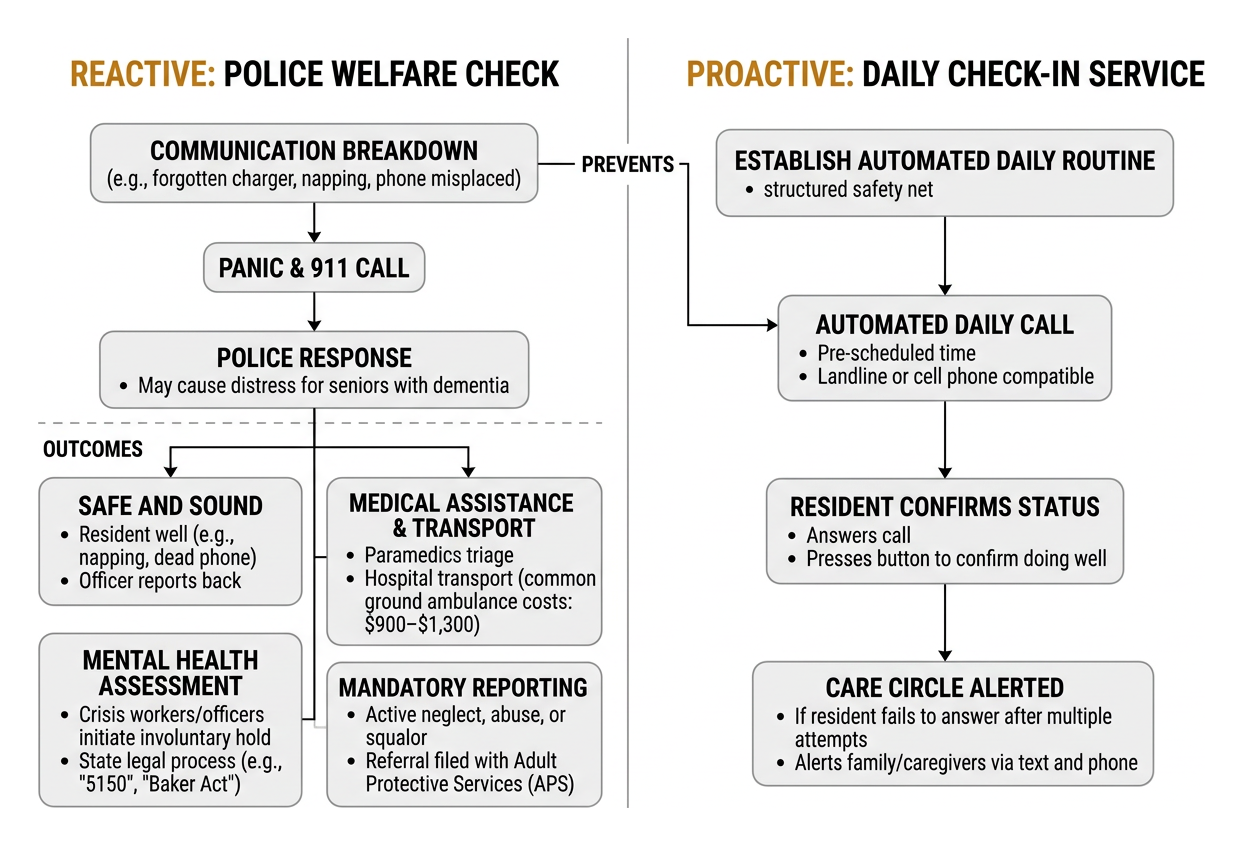
Establishing an automated daily routine helps prevent these frightening communication gaps. Rather than waiting for a missed Sunday call to spark panic, exploring how automated check-in systems work allows families to build a structured safety net.
At Caregiver365, we provide an automated daily phone-call check-in service designed specifically for independent seniors.
- Universal Compatibility: The service calls your loved one’s existing landline or cell phone at a pre-scheduled time every day—no apps, wearable pendants, or new hardware required.
- Care Circle Alerts: When your parent answers and presses a button to confirm they are doing well, their day continues uninterrupted. If they fail to answer after multiple automated attempts, our system immediately alerts their designated “Care Circle” of up to eight family members and caregivers via text and phone.
- Early Detection: This proactive approach gives families hours of early warning to reach out to a neighbor or visit the home personally, resolving issues long before an emergency welfare check becomes necessary.
Frequently Asked Questions About Senior Welfare Checks
Can I request a welfare check anonymously?
Yes, most municipal police departments and sheriff’s offices allow callers to remain anonymous. However, identifying yourself and providing a callback number is strongly recommended. Providing your contact details enhances the credibility and priority of the request, enables dispatchers to call you back for additional gate codes or pet details, and allows the responding officer to update you on your loved one’s status.
Does requesting a senior welfare check cost money?
No. Welfare checks conducted by local law enforcement or municipal public safety agencies are a free public service funded by taxpayer dollars. You will not receive a bill simply because an officer drove to the home and knocked on the door. Financial charges only arise if external medical intervention is required, such as paramedic treatment, emergency room admission, or private ground ambulance transportation.
What happens if an elderly person refuses to open the door?
If the resident is conscious and speaks through the door stating they are fine and refusing entry, officers cannot legally force their way in unless they observe specific evidence of imminent danger or severe medical distress (such as visible blood, smoke, or disorientation indicating an altered mental state). If the senior appears lucid and independent, officers will document that verbal contact was made, ensure no visible distress was observed, and notify the requester that the resident chose not to open the door.
Conclusion
Requesting a welfare check is an act of deep care and responsibility. When an aging parent or vulnerable relative stops answering the phone, knowing whether to dial 911, contact non-emergency dispatch, or reach out to specialized crisis resources gives you the clarity needed to act decisively. Always provide clear, actionable details to dispatchers, remain by your phone for updates, and respect the legal boundaries that protect your loved one’s privacy.
To protect your family from the stress of emergency safety checks, discover how daily check-in calls work with Caregiver365. By establishing a reliable daily touchpoint that alerts your Care Circle at the first sign of silence, you can ensure your loved ones remain safe, independent, and connected every single day.